
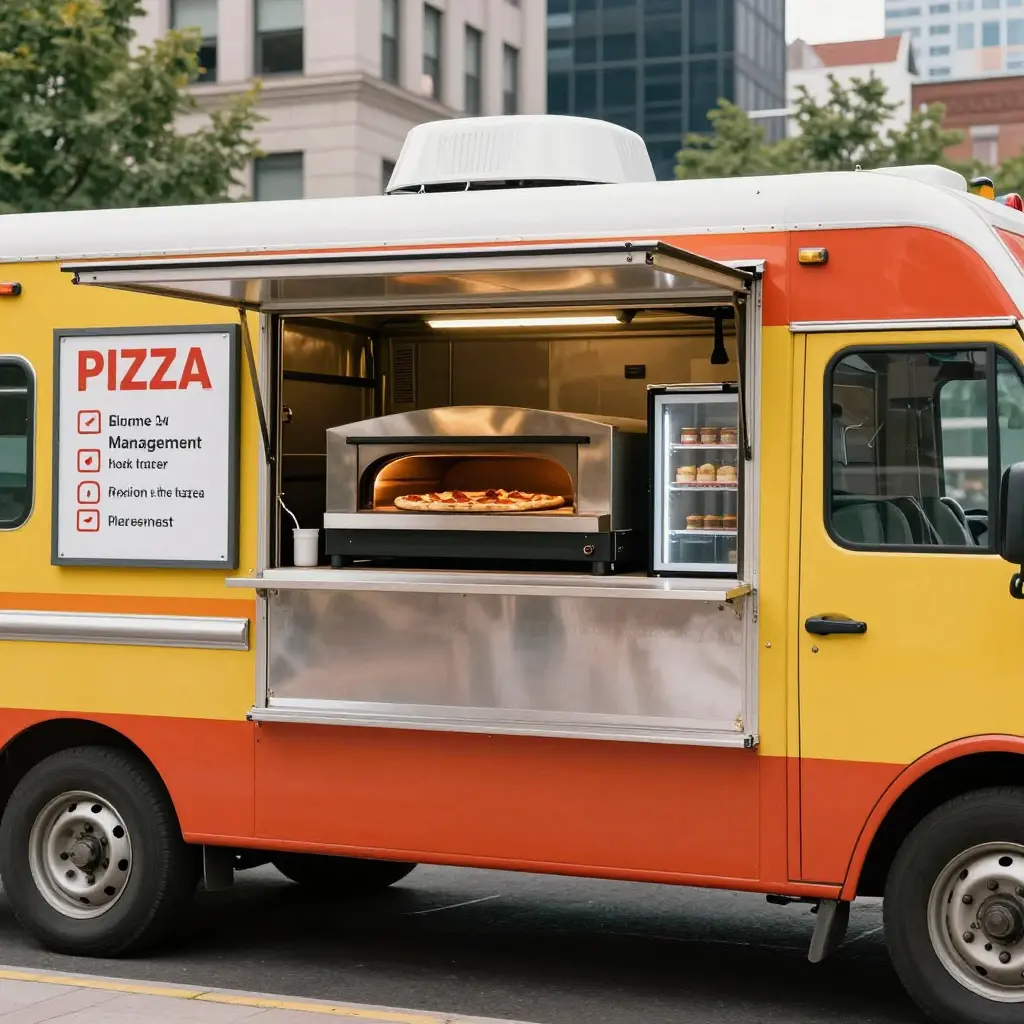
Pizza Truck Generator Sizing: What Happens When the Oven and Fridge Start Together
The Core Problem: Everything Draws Power at Once
A pizza truck runs its whole kitchen off one generator. The oven, fridge, lights, and point-of-sale system all pull from the same source, and most of the time the load stays ordinary. The trouble is the second when the oven and fridge start together. An undersized unit cannot absorb that overlap, so it trips or stalls.
That overlapping startup surge is the most common way mobile operators lose power in the middle of service. It shows up as flickering lights, a tripped breaker, or a full shutdown with a line of customers waiting.
The average afternoon is easy. The worst second of the shift is what you are actually sizing for.
Why Simultaneous Startup Matters
Motors and compressors pull far more power at the instant they start than while they run. A refrigerator compressor can demand three to five times its running wattage for a few brief seconds.
A pizza oven adds its own spike, whether it is a motorized conveyor or a blower-assisted deck. When both devices energize at once, those spikes land on top of each other.
A generator sized for average load has no reserve left for a stacked surge, so its protection circuits cut power to save the equipment.
Food truck generator sizing that ignores this stacking leaves you with a unit that runs fine all afternoon and fails at the moment of peak orders.
The Two Numbers Behind Mobile Pizza Oven Power
Every appliance carries two ratings, and they measure different things:
- Running watts: the steady power a device draws once it is fully on.
- Starting watts (surge): the brief, higher draw needed to start a motor or compressor.
Add the running watts of everything on the truck, then stack the single largest surge on top. That combined figure is your real peak demand.
| Equipment | Running Watts | Starting Watts |
|---|---|---|
| Refrigerator compressor | 200-400 | 600-1,200 |
| Conveyor pizza oven | 2,000-3,000 | 3,000-4,500 |
| Propane deck oven blower | 300-600 | 900-1,500 |
| Lights and POS system | 200-400 | 200-400 |
Most operators fill in only the first column and stop there. That is why the generator dies when the oven and fridge start together.
Why Starting Everything at Once Trips a Generator
An electric motor draws a modest amount of power once it is up to speed. The instant it switches on, it pulls several times that much before settling down. Run one appliance alone and a properly sized generator barely notices. Run several at the same moment and the demands stack. The total can briefly exceed the generator’s continuous rating, and the result is a dimming oven, a stalled compressor, or a tripped breaker.
That single moment separates a smooth service from a mid-rush shutdown.
What Is Inrush Current?
Inrush current is the heavy burst of electricity a device pulls in the first split second after it turns on. It is like the first hard pedal strokes on a bicycle: far more effort than cruising, but only for a moment. Once the device is moving, the draw drops to its normal running level.
Most kitchen equipment uses motors and coils that resist sudden changes in current. In the instant before the magnetic field builds, they behave almost like a dead short and pull whatever the circuit will give them.
What Are Locked Rotor Amps (LRA)?
Locked rotor amps (LRA) is the maximum current a motor draws while its shaft is not yet spinning. At startup the rotor, the part that turns, is momentarily “locked” in place. Until it moves, the motor cannot generate the back-pressure that normally limits its draw, so it pulls peak current. That LRA figure, often printed on a compressor nameplate, is the worst-case surge an appliance can demand.
Key takeaways:
- Running amps – the steady, modest current once everything is spinning.
- Inrush / LRA – the brief, oversized spike right at startup.
- Surge duration – short, but long enough to matter for a generator.
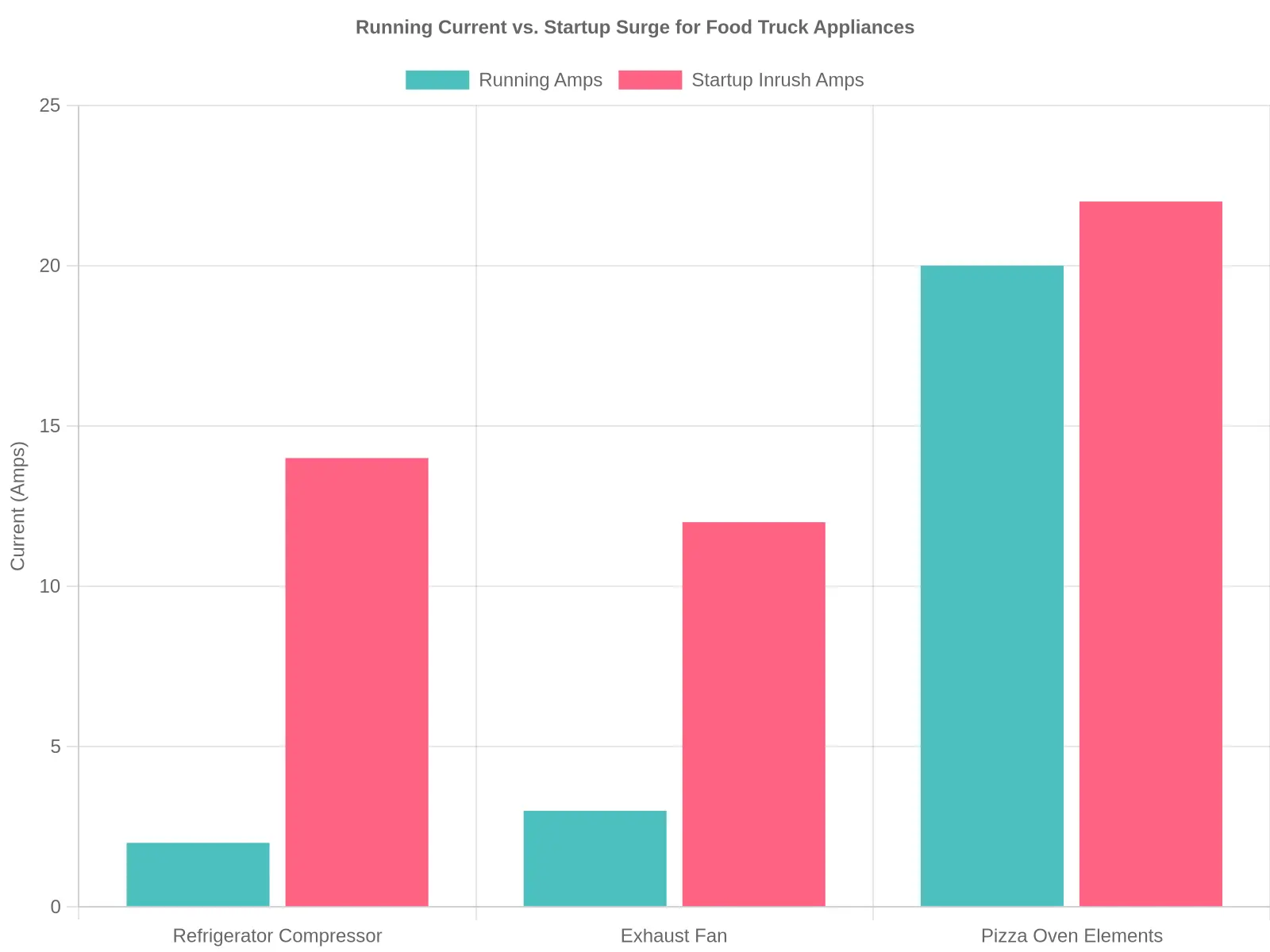
When the Oven and Fridge Start Together
This is where a food truck gets uncomfortable. Picture the moment the oven and fridge start together, with the exhaust fan joining in:
- Refrigerator compressor: an inductive load. Its locked-rotor inrush can reach five to seven times running amps for a fraction of a second, though generator sizing tables usually plan for about three times running watts.
- Exhaust fan: another motor, another sharp inrush spike the instant it energizes.
- Pizza oven elements: largely resistive, so they climb to close to their rated current almost immediately and hold there.
Individually, each is manageable. Stacked, the brief surges from the compressor and the fan sit on top of the oven’s already-substantial steady draw. For a heartbeat, total demand can leap beyond the generator’s continuous rating even though it handles all three appliances running normally. Pizza truck generator sizing therefore has to account for the worst-case stack of startup surges, not just the sum of running watts.
Why This Matters for Pizza Truck Generator Sizing
Size a generator around running loads alone and you will be fine on paper and frustrated in reality. The unit has to absorb the combined surge during simultaneous starts without browning out. A few practical safeguards:
- Stagger your starts. Let the fridge stabilize before firing the oven.
- Look at LRA, not just watts. Add the biggest surge on top of the steady load of everything else.
- Give the generator headroom. A little oversizing beats tripping mid-service.
Manage the startup surge and your equipment starts cleanly, your compressor lasts longer, and your generator stays inside its limits.
Typical Power Draw: Pizza Truck Appliances
The table below maps what each appliance demands on its own. Pay close attention to the surge column. This is where generator sizing usually goes wrong, because the number that matters is the peak draw, not the steady-state draw.
| Appliance | Running Watts (continuous) | Startup Surge Watts (approx. multiplier) | Notes |
|---|---|---|---|
| Commercial pizza oven (deck) | 3,000 – 6,000 W | ~1x (3,000 – 6,000 W) | Resistive heating elements draw almost no extra inrush; the real load is sustained heat-up. |
| Convection oven | 2,000 – 3,000 W | ~1.2x (2,400 – 3,600 W) | Heavy resistive draw; the circulation fan adds a small motor surge on top. |
| Refrigerator / fridge compressor | 150 – 400 W | 3x (450 – 1,200 W) | Motor-driven: locked-rotor current spikes hard for a split second. The classic “fridge kick.” |
| Chest freezer | 200 – 350 W | 3x (600 – 1,050 W) | Same compressor physics as the fridge; surges each time it cycles on. |
| Exhaust hood fan | 200 – 500 W | 2-3x (400 – 1,500 W) | Fan motor with moderate inertia; surge depends on blade size and start winding. |
| Dough mixer | 500 – 1,500 W | 3x (1,500 – 4,500 W) | High-torque gearbox motor starting under load; one of the harshest surges on the truck. |
| POS system | 50 – 150 W | ~1x (50 – 150 W) | Electronics with a switch-mode supply; negligible startup surge. |
| LED lighting | 50 – 300 W | ~1x (50 – 300 W) | Solid-state drivers; effectively no inrush to worry about when sizing. |
Reading the surge column. Resistive and electronic loads (ovens, POS, LED) run at roughly their continuous rating and barely spike. Motor loads (compressors, fans, mixers) pull a locked-rotor surge for a fraction of a second during startup; plan on 2x to 3x their running watts. Engineers size for the worst-case sum: the largest single surge plus everything else running at that instant. A fridge and a dough mixer tripping at the same moment can overwhelm a generator that looks fine on paper.
How Generators Are Sized: Running Watts vs. Surge Watts
Every appliance on a pizza truck pulls electricity in two ways: the steady draw while it runs, and the brief spike when it starts. Generator sizing comes down to understanding both numbers, then leaving enough headroom so nothing trips when the oven and the fridge kick on together.
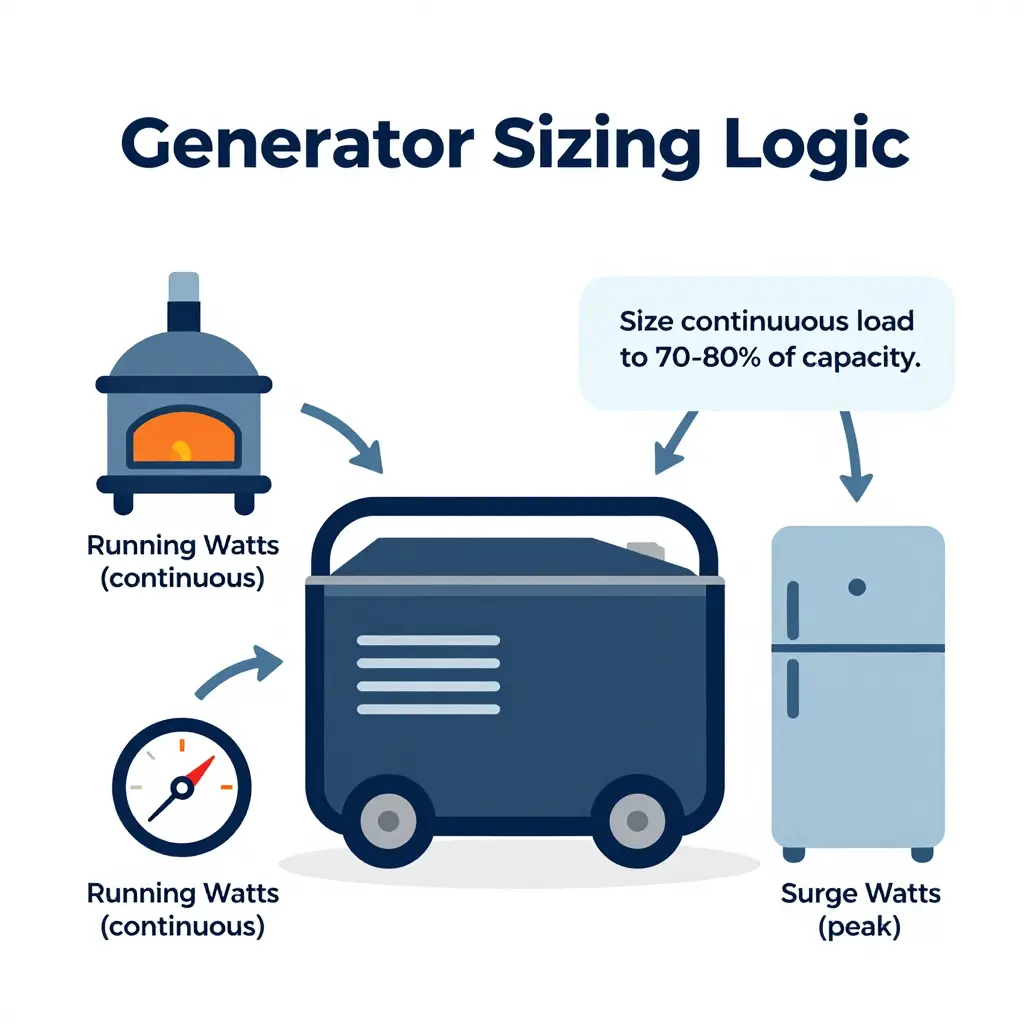
The Two Ratings That Matter
Manufacturers list two power figures on every generator label, and they are not interchangeable.
Continuous (running) watts describe the power a generator can deliver all day without overheating. That is the number that keeps your pizza oven hot, your refrigerator cold, and your lights on through a long service.
Generator peak watts describe a short burst of extra power, usually lasting just a few seconds, to handle motor startup. Compressors and other motor-driven appliances draw far more current at the instant they start than while they run.
How Manufacturers Label Them
Labels are not standardized, so read them carefully. You may see “running watts” and “starting watts,” or “rated watts” and “peak watts,” or “continuous output” and “maximum output.” Some brands quote the surge duration (10 seconds, for example) or list separate gasoline and LPG ratings. Confirm which number is the steady load and which one is temporary.
Why Starting Loads Change the Math
A commercial refrigerator might run at 700W but surge to 2,100W when its compressor engages. Across several appliances, startup demand can double or triple the running total. When the pizza oven, fridge, and mixer restart at the same moment, their surges stack, and that is when an undersized generator stalls or a breaker pops.
The chart below compares running watts and surge watts for common pizza truck appliances.
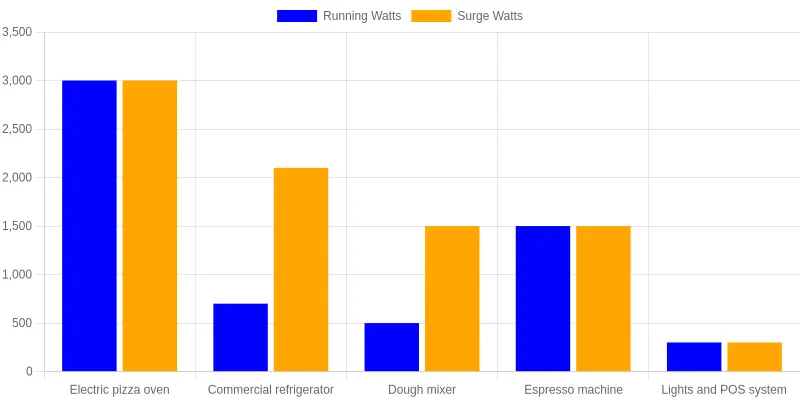
| Appliance | Running Watts | Surge Watts |
|---|---|---|
| Electric pizza oven | 3,000 | 3,000 |
| Commercial refrigerator | 700 | 2,100 |
| Dough mixer | 500 | 1,500 |
| Espresso machine | 1,500 | 1,500 |
| Lights and POS | 300 | 300 |
Duty Cycle and Load Factor
Duty cycle is the share of time a device actually draws power during a period. A fridge compressor might run only 30-40% of the time, cycling on and off, while a pizza oven runs near 100% during service.
Load factor is the ratio of average load to peak load. A low load factor means demand swings a lot, which is typical on a truck where appliances start at different moments. Both numbers help you avoid sizing for a worst-case spike that rarely happens all at once.
The 70-80% Safety Margin
A common rule in pizza truck generator sizing is to keep your continuous load at about 70-80% of the generator’s running capacity. That headroom covers:
- Appliance start surges that push past the steady draw
- Ambient heat, altitude, and fuel quality that reduce real-world output
- Aging equipment that draws slightly more power over time
If your continuous load totals 4,000W, aim for a generator with roughly 5,000-5,700W of running capacity.
Sizing Logic at a Glance
- Add up the running watts of everything you expect on at once.
- Identify motor- and compressor-driven items and note their surge watts.
- Keep the continuous load at 70-80% of the generator’s running rating.
- Confirm the peak watts exceed your largest single surge plus the steady load.
Get those four steps right and your busiest service window is far less likely to end in silence.
Watching the Surge: Power Demand When the Oven and Fridge Fire Up Together
Generators do not care about your menu, only about timing. A fridge compressor and a pizza oven each draw a quick burst of current when they kick on. If those bursts land on the same second, the total can blow past what your generator can sustain. The chart below plots total wattage for the first ten seconds of a shift in two very different worlds.
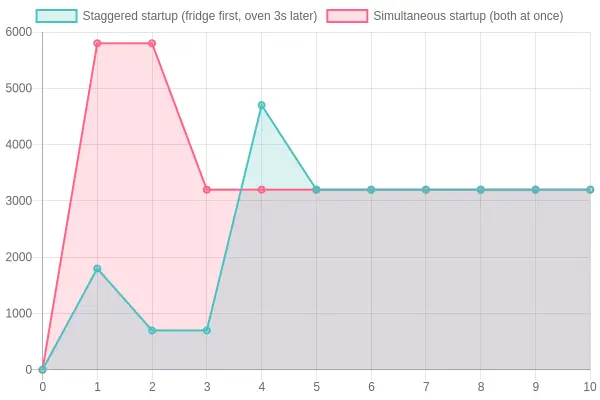
The horizontal dashed line marks the generator’s continuous capacity at 5,000 W, the ceiling the unit can hold all day without overheating, tripping a breaker, or slowly cooking itself. Anything above that line is borrowed time.
How to Read the Two Lines
- Staggered startup (teal line): The fridge kicks on first at second 1, pulls a brief 1,800 W surge, then settles to about 700 W. Three seconds later the oven ignites, adding its 4,000 W surge on top of the running fridge. The result peaks at 4,700 W, close to but still under the 5,000 W line.
- Simultaneous startup (red line): Both appliances demand their surge in the same instant. The combined 5,800 W spike crashes through the continuous capacity line and lingers for two seconds. That is when lights dim, the generator stumbles, or a breaker snaps.
The Data Behind the Chart
| Time (s) | Staggered startup (W) | Simultaneous startup (W) | Generator continuous capacity (W) |
|---|---|---|---|
| 0 | 0 | 0 | 5000 |
| 1 | 1800 | 5800 | 5000 |
| 2 | 700 | 5800 | 5000 |
| 3 | 700 | 3200 | 5000 |
| 4 | 4700 | 3200 | 5000 |
| 5 | 3200 | 3200 | 5000 |
| 6 | 3200 | 3200 | 5000 |
| 7 | 3200 | 3200 | 5000 |
| 8 | 3200 | 3200 | 5000 |
| 9 | 3200 | 3200 | 5000 |
| 10 | 3200 | 3200 | 5000 |
Why the Numbers Matter for Sizing
Notice that both scenarios settle into the same steady state, 3,200 W of running load. That is the trap. A generator sized only for running watts looks perfectly adequate right up until both appliances start at once and demand nearly double that figure. This is why experienced operators size around surge watts, then confirm the math with a real start-up test.
A simple fix beats a bigger generator almost every time: sequence the starts. Let the fridge settle for a few seconds before you fire the oven, and the same machine that looked overloaded suddenly has headroom. Breaking a chaotic sequence into ordered steps is the same discipline behind the goal-setting strategies that keep complex routines on track, and it pays off whether you are running a kitchen or a service window.
The takeaway: the oven and the fridge can run together all shift long. They just should not start together. Give each surge its own moment and your generator stays calm, your breakers stay closed, and your pies keep coming.
What Actually Happens When the Oven and Fridge Start Together
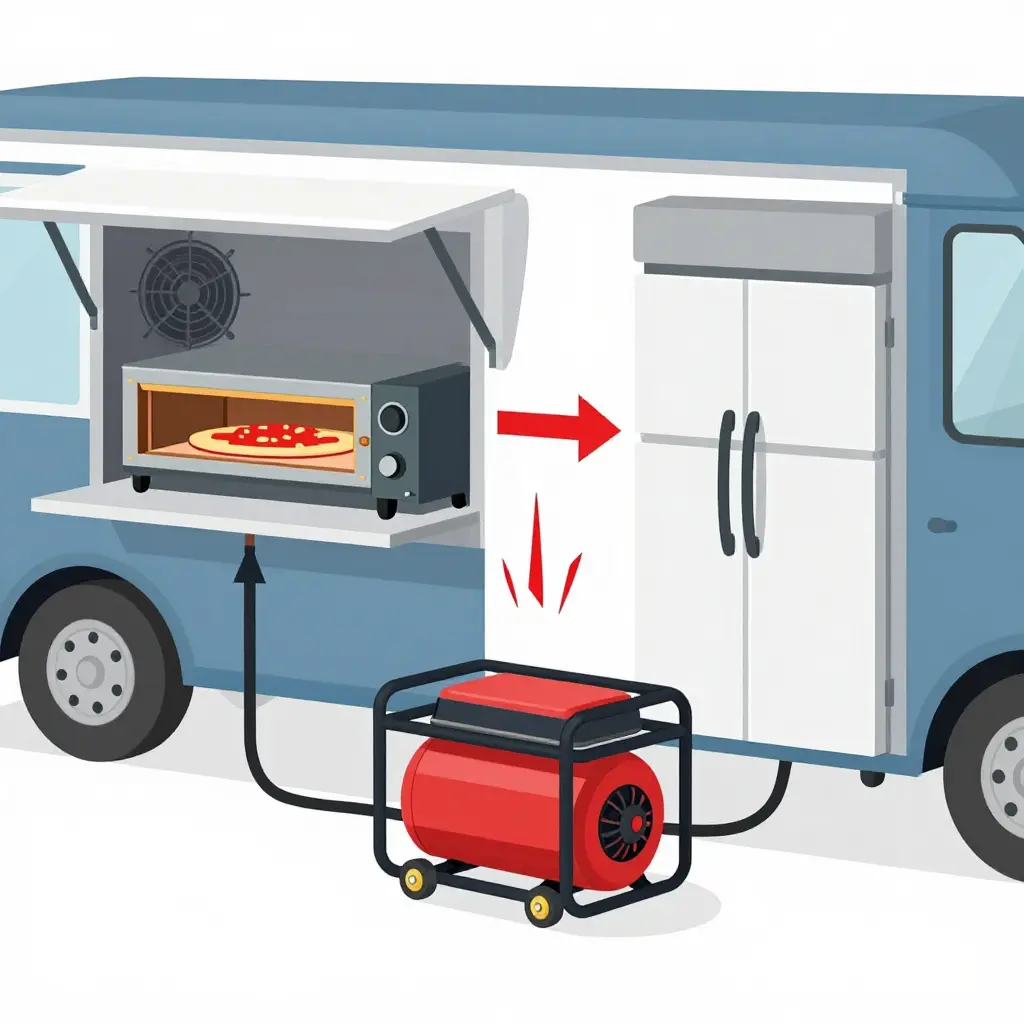
When a pizza oven and a refrigerator energize at the same moment, their combined starting demand can exceed what the generator can supply. The result is not a gentle slowdown but a brief, sharp competition for current that surfaces as voltage drops, breaker trips, or a stalling engine. This single instant is why pizza truck generator sizing matters far more than a simple tally of running watts suggests.
The Moment of Simultaneous Startup
Every appliance draws more power in the instant it starts than it does while running. The fridge compressor motor needs a large inrush current to overcome the pressure sitting in the refrigerant lines before it can settle into steady operation.
The pizza oven adds its own surge on top. Its heating elements and convection fan switch on together, so resistive and inductive loads stack rather than arriving one after another.
When both events coincide, the generator faces a peak load several times larger than the steady-state total. That peak lasts a fraction of a second, but it is often enough to decide whether the whole system works or fails.
Why Inrush Current Overwhelms the Generator
A generator has two limits: its continuous running capacity and its ability to absorb short bursts. The burst capability, sometimes called surge or motor-starting capacity, is finite and typically only modestly higher than the rated output.
The fridge compressor’s locked-rotor amperage can run five to seven times its normal running current. If the oven’s elements are drawing full power at the same time, the combined demand can climb past the generator’s surge ceiling.
Once demand exceeds supply, the generator cannot simply hand over extra power. The mismatch has to go somewhere, and it shows up as a drop in voltage across the entire electrical system.
What a Food Truck Generator Overload Looks Like
A food truck generator overload rarely announces itself. Instead it produces a cluster of symptoms operators can learn to recognize before they lose a service.
Voltage sag is the most immediate sign. Lights dim or flicker, digital displays reset, and voltage-sensitive equipment may behave erratically.
Breakers may trip to protect the wiring, cutting power to a single circuit or to the whole panel. In more severe cases the generator itself stalls because the engine cannot hold its speed against the sudden load.
The fridge is often the most visible casualty. If voltage sags during compressor startup, the compressor cannot build enough torque to run, so it fails to start and tries again shortly after. That short-cycling pattern stresses the motor and puts food safety at risk.
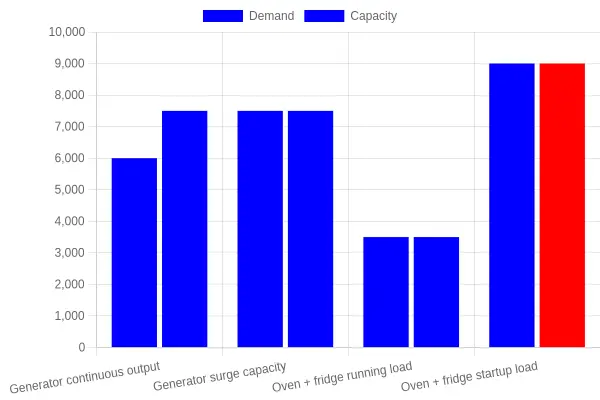
The chart below shows how a combined startup load can climb above both the continuous and surge limits of a typical generator.
| Load Condition | Typical Demand (W) | Notes |
|---|---|---|
| Oven + fridge, running together | 3,000 – 4,000 | Steady-state, well within capacity |
| Fridge compressor startup only | 1,500 – 4,000 | Brief inrush spike |
| Oven elements + fan startup | 2,000 – 3,000 | Resistive load, fast ramp |
| Oven + fridge starting together | 8,000 – 10,000+ | Can exceed generator surge ceiling |
How ATS and Load-Shedding Systems Respond
An automatic transfer switch (ATS) manages the handoff between power sources, and its behavior depends on how it is configured. If the generator cannot hold voltage during the combined startup, the ATS may read the dip as a source failure.
Some systems are set to delay or revert, which can leave the truck temporarily without power. Load-shedding controllers take a different route by prioritizing circuits instead of fighting the peak.
A load-shedding setup may delay the fridge compressor or the oven’s second element until the first load has stabilized. That sequencing prevents the peak from ever forming, trading a few seconds of startup time for a stable, uninterrupted supply.
What This Means for Pizza Truck Generator Sizing
Sizing cannot rely on adding up running watts alone. The generator has to handle the worst-case combination of inrush events, not just the everyday steady load.
Operators should identify which appliances tend to start at the same time and how large their starting surges are. A generous surge margin, or deliberate load sequencing, is what keeps a pizza truck running through the busiest service.
Solid pizza truck generator sizing blends the arithmetic of continuous load with an honest look at startup behavior. When the oven and fridge start together, it is that surge margin, not the running total, that decides the outcome.
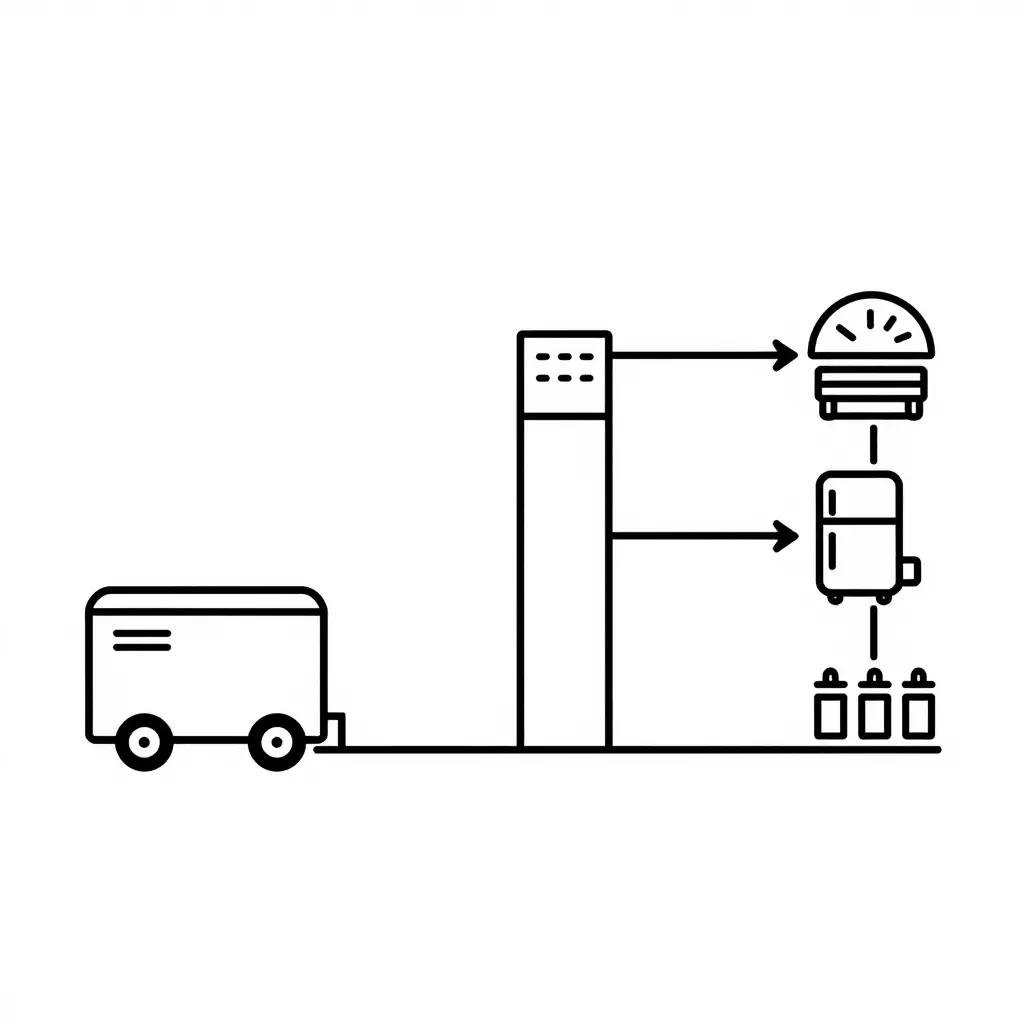
Figure: A simplified power distribution path inside a pizza truck. The generator feeds a single distribution panel, which then branches to the pizza oven, the fridge compressor, and auxiliary loads. The start-sequence arrow across the fridge and oven branches highlights what happens when both engage at nearly the same moment – the surge overlap that drives your generator sizing.
Step-by-Step: Sizing Your Pizza Truck Generator
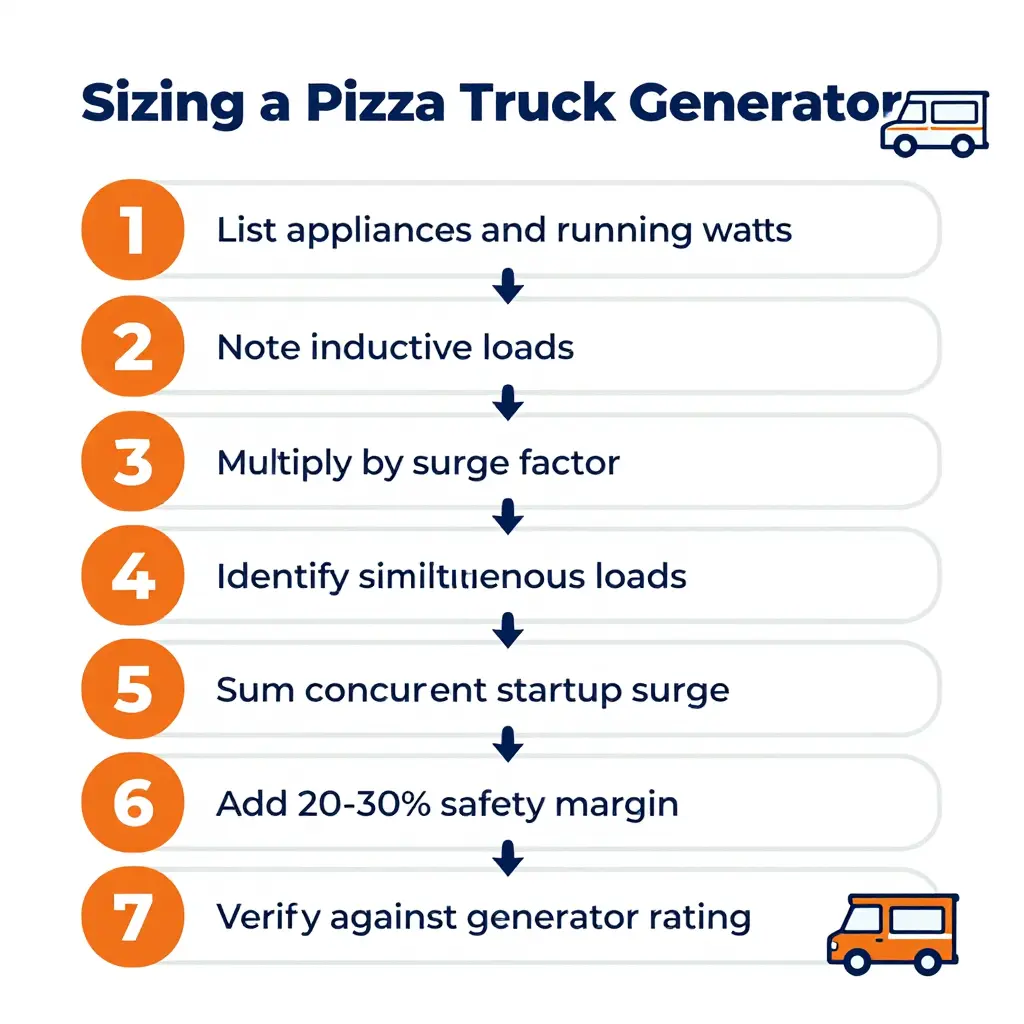
The biggest unit on the shelf is rarely the right one. Match the watts to the way your truck actually runs, work through these seven steps in order, and you will land on a number you can defend before you ever turn the key.
-
List every appliance and its running watts. Walk your truck front to back and write down every electrical load: pizza oven, dough mixer, refrigerators, exhaust fan, air conditioner, lights, POS system, and the phone charger by the register. For each one, record the running watts, sometimes called continuous watts, printed on the data plate or listed in the manual rather than guessing. This master list is the backbone of all pizza truck generator sizing, because you cannot size what you have not counted.
-
Note which loads are inductive. Inductive loads use motors or compressors and pull a short burst of extra power, called surge or inrush, the instant they start. On a pizza truck that usually means the refrigerator compressors, the dough mixer, the exhaust fan, and the air conditioner, while resistive loads like the oven and lights start smoothly. Mark these clearly, because they behave very differently from steady heaters.
-
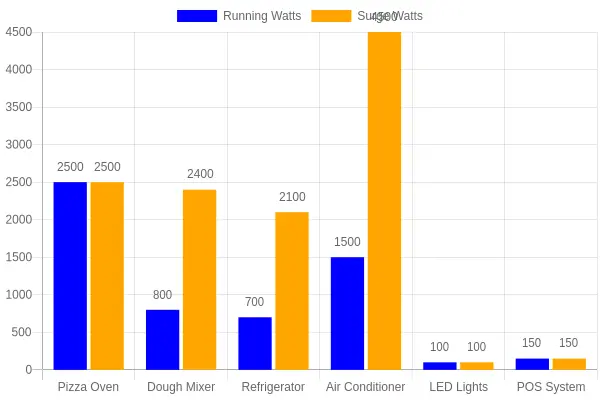
Multiply motor loads by their surge factor. Take each inductive load and multiply its running watts by its typical surge factor, roughly 2-3x for small motors and 3-4x for large ones. A 700-watt fridge compressor, for example, can momentarily demand about 2,100 watts, and the dough mixer might leap from 800 to 2,400. This step turns a modest-looking appliance list into the real worst-case number your generator has to survive.
-
Identify which appliances run simultaneously. In practice you rarely start everything at once, so map out what is genuinely on together, say lunch rush with the oven, both fridges, the exhaust fan, and lights all running. The real risk hides in the overlaps, like the moment the air conditioner and a fridge compressor cycle on within the same second. Being honest about concurrency keeps you from oversizing, which wastes fuel and money.
-
Sum concurrent startup surge. Add the running watts of everything that stays on, then add the single largest surge (or the combined surge of any loads you know start together) on top. Resist adding every surge at once. That is a rare, near-impossible scenario that would push you into a needlessly huge machine. Build a realistic peak that reflects your busiest few seconds instead.
-
Add a 20-30% safety margin. Once you have a working peak, add 20-30% headroom so the generator never runs flat-out at its limit. Engines operated at full load constantly wear faster, drink more fuel, and run louder, while a little breathing room absorbs aging equipment and hot summer days. Round up to a comfortable number rather than shaving it to the bone.
-
Verify peak watts against generator ratings. Check your total against both the generator’s continuous (running) rating and its surge rating. Your peak watts must fall under the surge figure, and your everyday load must sit under the continuous figure. Most manufacturers publish both numbers, so match them deliberately rather than trusting a single “max watts” sticker. If a unit’s surge rating clears your peak with margin to spare, you have sized it correctly.
Quick Reference: Typical Surge Factors
| Load type | Examples on a pizza truck | Typical surge factor |
|---|---|---|
| Resistive | Pizza oven, lights, warming elements | 1.0x |
| Small motor | Refrigerator, exhaust fan | 2-3x |
| Large motor | Dough mixer, air conditioner | 3-4x |
Run the numbers once with realistic assumptions and the oven-and-fridge scenario stops being a mystery: the fridge surge rides on top of your steady load, and a properly sized generator barely notices. Size for the overlap you will actually see, keep a little margin, and your pizza truck keeps baking through the dinner rush.
The Real Costs of an Undersized Generator
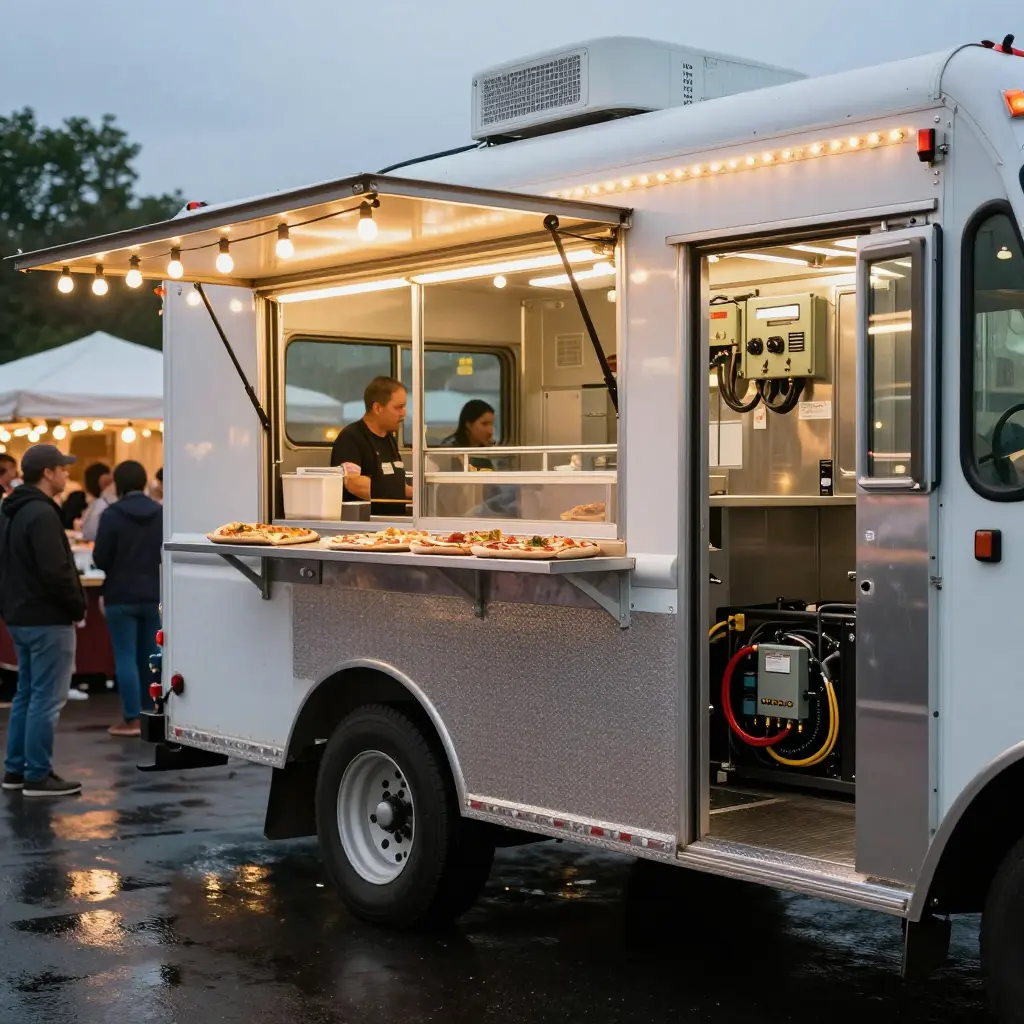
A pizza truck concentrates a heavy electrical load into a very small footprint. A convection oven, a dough and cheese fridge, an exhaust hood, lights, a POS tablet, and a water heater or coffee urn can all demand power within the same 30 seconds. An undersized food truck generator does not simply run a little harder; it changes how the entire service day unfolds.
Breaker Trips During Service Rushes
Electrical load is not steady. Motor inrush current can run three to five times the running draw for a fraction of a second when a compressor starts; resistive heating elements climb quickly but do not overshoot the same way. If the generator and its breakers are sized around average load instead of peak, the main breaker trips the moment the oven cycles on while the fridge compressor kicks in.
The practical result is a scramble: staff reset breakers mid-queue, oven recovery time stretches, and the customers who arrived during the busiest ten minutes of the night wait the longest.
Fridge Temperature Swings That Threaten Food Safety
When a generator is pushed past its rating, both voltage and frequency sag. A compressor motor that sees low voltage draws higher current, runs hotter, and may stall instead of starting. Each failed start is a minute or two of warming, and short-cycling repeats that warming all evening.
Dough, cheese, sauce, and prepped toppings held above 41°F (5°C) for more than two hours become a discard risk. Even swings that stay technically safe shorten shelf life, soften dough, and force you to throw away product you paid for.
Shortened Lifespan for Generators and Compressors
Running continuously near or above rated capacity keeps generator windings hot, thins the oil film in the engine, and stresses the voltage regulator, brushes, and control board. On the equipment side, hard starting damages start relays, run capacitors, and eventually the compressor itself. Repairs cluster in the middle of your season, when you can least afford a down truck.
Fuel Burned for Nothing
A small unit running at its limit often burns nearly as much fuel per hour as a larger unit operating at 60 to 70 percent load. You pay for fuel, generator noise, and extra refueling runs while delivering less usable power per gallon. Hour meters and fuel receipts rarely lie: undersizing is expensive every single day.
Lost Sales During Downtime
Downtime is the most expensive failure of all. A dark truck at a festival or brewery lot is lost revenue, refunded orders, and a dent in the reputation you built to win that booking in the first place. Food truck scheduling is referral-driven, and one bad night travels faster than any social post.
Consequences in Short
- Tripped main breakers and repeated manual resets during peak service
- Fridge and freezer temperature swings that risk food safety and trigger waste
- Hard starts and heat damage that shorten generator and compressor lifespan
- Higher fuel consumption per kilowatt-hour actually delivered
- Lost sales, refunds, and reputation damage every time the truck goes dark
Load and Capacity at a Glance
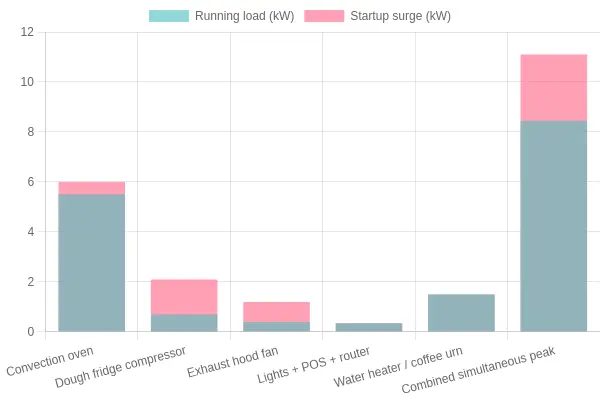
| Equipment | Running load (kW) | Startup surge (kW) |
|---|---|---|
| Convection oven | 5.5 | 6.0 |
| Dough / cheese fridge compressor | 0.7 | 2.1 |
| Exhaust hood fan | 0.4 | 1.2 |
| Lights, POS, router | 0.35 | 0.35 |
| Water heater / coffee urn | 1.5 | 1.5 |
| Combined simultaneous peak | 8.45 | 11.1 |
The combined peak is what matters. A 6 kW unit never carries this truck; a 12 kW unit with headroom carries it comfortably.
What Correct Food Truck Generator Sizing Delivers
Sizing around the measured simultaneous peak, plus 20 to 25 percent headroom, converts every problem above into an operational advantage.
Stable Voltage for Sensitive Equipment
A generator operating well inside its rating holds steady voltage and frequency. Ovens reach temperature and stay there, compressors start cleanly, and control boards, ignition modules, and digital thermostats stop seeing the spikes that quietly shorten their lives.
Reliable Simultaneous Startup
Correct sizing means the oven, fridge, exhaust fan, and lights can all start together without negotiation. No more staged switch-on rituals, no more asking a customer to wait while you reset a breaker. Your crew works the same sequence every shift and it simply works.
Longer Equipment Life
Engines that run at moderate load instead of redline last longer between services, and compressors that start softly avoid the hard-start damage that ends in premature replacement. Lower operating temperature also means fewer mid-season emergency repairs.
Smoother Daily Operation
Stable power makes the truck predictable: consistent bake times, consistent fridge temperatures, fewer interruptions, and fuel consumption that scales with actual work rather than with strain. Predictability is what turns a busy night into profit instead of a repair bill.
The difference between a 6 kW and a properly matched unit shows up at 6 p.m. on a Friday, when your oven and fridge either start together or they don’t. It decides whether you go home with sales or with a truck that needs parts.
Typical Load Distribution on a Pizza Truck
Before you can size a generator, you need to know where the power actually goes. Most pizza trucks look busier than they are electrically. The crowd of appliances hides a simple truth: two pieces of equipment carry the load.
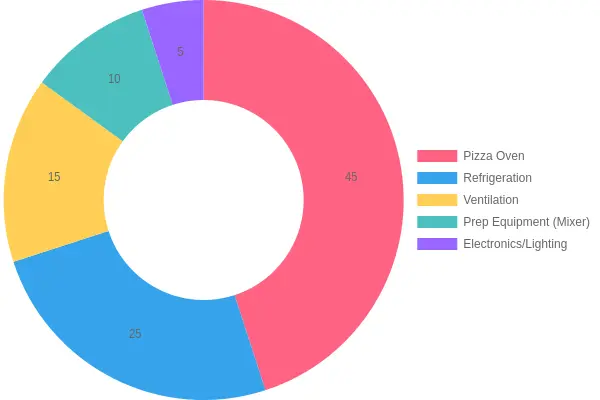
| Appliance Category | Share of Running Load |
|---|---|
| Pizza Oven | 45% |
| Refrigeration | 25% |
| Ventilation | 15% |
| Prep Equipment (Mixer) | 10% |
| Electronics / Lighting | 5% |
| Total | 100% |
Note: Refrigeration and the oven together account for roughly 70% of the running load. That is exactly why their simultaneous startup, not the steady-state draw, is the real sizing bottleneck.
Why the Startup Moment Matters
Those percentages describe running load, the watts consumed once everything is humming along. Starting is a different story. The oven’s heat-up cycle and the fridge compressor’s inrush both spike far above their steady draws, and if their surges land at the same moment, the combined peak can dwarf the running total. That single overlap is what forces you to choose a larger generator than the chart alone would suggest.
Mitigation Strategies for Handling Simultaneous Startup
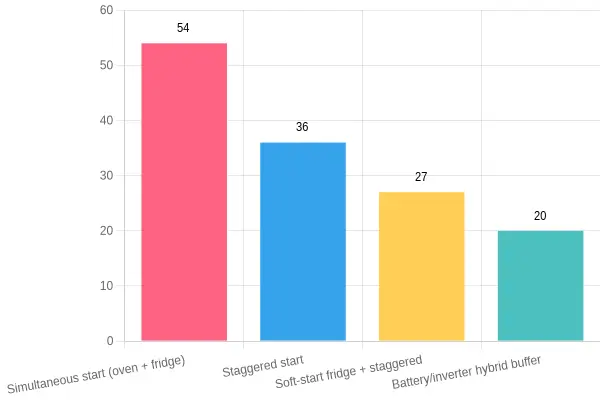
A pizza truck’s electrical system is only as strong as its weakest moment, and that moment usually arrives the instant the deck oven and the fridge compressor try to start at the same time. The two loads behave very differently. The oven’s heating elements pull a large, fairly steady draw, while the fridge’s compressor motor demands a short but intense inrush current that can briefly run several times its normal running rating. When those spikes collide, the result is often a tripped breaker, a stalled generator, a browned-out display, or quiet long-term wear on your equipment. The good news is that you do not have to accept that collision as inevitable. Several proven approaches smooth it out, and most of them work best in combination. Here is a quick overview, followed by a closer look at each one.
- Staggered start sequencing – control the order in which loads power up.
- Soft-start devices on the fridge compressor – reduce the inrush spike at its source.
- Load-shedding controllers – automatically pause non-critical loads when demand peaks.
- Upgraded inverter generators – choose a unit with genuine surge headroom.
- A properly sized battery/inverter hybrid system – buffer startup spikes with stored energy.
Staggered start sequencing
The simplest and least expensive fix is to stop letting everything switch on at once. Staggered start sequencing means deliberately powering up loads one after another, so the generator or shore connection only has to absorb one startup surge at a time. In practice you bring the fridge online first, let its compressor settle into steady running, and only then fire the oven. Since the oven draws heavily for a sustained period while the fridge spike lasts only moments, separating them by even fifteen to thirty seconds can keep your total peak demand well inside the system’s comfort zone. You can do this manually through labeled switches, or automate it with a simple delay relay that holds the oven contactor closed for a short interval after the main breaker closes.
Soft-start devices on the fridge compressor
Staggering reduces when the spike happens, but a soft-start device reduces how large that spike is. A soft-start module ramps the compressor motor up gradually rather than slamming it to full current the instant it engages. Instead of a brief but brutal inrush, the motor accelerates smoothly, which can cut the starting current dramatically. This matters on a truck because the compressor is the load most likely to cycle on unexpectedly mid-service, right when the oven is already running. Fitting a soft-start is a modest upgrade that pays for itself by reducing breaker trips and easing stress on the compressor itself.
Load-shedding controllers
A load-shedding controller acts like a traffic officer for your electrical panel. It continuously monitors total demand and, when the system approaches a threshold, temporarily interrupts or delays lower-priority loads so the critical ones can run. On a pizza truck that might mean pausing the fridge, a warming lamp, or a display case for the few seconds the oven needs, then restoring them once the surge passes. Because load shedding is automatic, it protects you even during a busy rush when nobody has a hand free to flip a switch. The key is to program it with sensible priorities: cooking and refrigeration first, convenience loads last.
Upgraded inverter generators
When you revisit your pizza truck generator sizing, the number that matters most is not the steady running wattage but the surge capacity. Inverter generators pair a conventional engine with power electronics that produce clean, stable output, and many models offer an explicit surge rating well above their continuous rating. That headroom is exactly what absorbs a compressor’s combined inrush. If your current unit sits right at the edge of your calculated load, a modest upgrade to a model with more surge margin can eliminate nuisance shutdowns without forcing you to oversize the whole rig. Compare running watts, surge watts, and the starting requirement of your specific appliances rather than guessing.
A properly sized battery/inverter hybrid system
For the most demanding setups, a battery and inverter hybrid system is the most graceful solution. Instead of asking the generator to meet every spike on its own, the battery bank supplies the short burst of power that a compressor startup demands, then recharges during the calmer moments in between. The generator sees a smooth, predictable load, the oven keeps its steady draw, and the compressor gets the jolt it needs without dragging the entire system down. This architecture tends to cost more up front, but it allows a smaller, quieter generator to serve loads that would otherwise demand a much larger machine.
Putting the options together
These strategies are not mutually exclusive, and the most reliable trucks often layer several of them. A soft-start on the compressor plus staggered sequencing handles most everyday situations at low cost. Add a load-shedding controller and you gain automatic protection for unpredictable moments. Step up to an inverter generator with real surge headroom or a battery/inverter hybrid, and you build in a margin that keeps service running no matter which appliances decide to start together. The goal is not simply a bigger generator but a smarter system that understands its own peaks and manages them before they become problems.
Pizza Truck Generator Sizing: Your Top Questions Answered
Choosing the right generator can make or break a service day, and most pizza truck owners wrestle with the same handful of worries. Below are answers to the questions we hear most often about pizza truck generator sizing, startup surge, and keeping your oven and fridge happy at the same time.
How many watts does a pizza truck need?
A typical pizza truck needs roughly 6,000 to 12,000 running watts, depending on whether you cook with electricity, propane, or a mix of both. An electric deck oven alone can pull 3,000 to 5,000 watts, and your fridge, lights, exhaust fan, POS system, and small appliances quickly add several thousand more. Solid pizza truck generator sizing means adding every load together and then leaving headroom for startup surge. When in doubt, size up rather than down.
What happens if my generator is too small for my oven and fridge?
If your food truck generator is undersized, you will usually notice flickering lights, voltage dips, and a tripped breaker the moment your oven and fridge demand power together. Chronic overload also creates heat that wears down the alternator and can shorten the life of your oven’s heating elements and your fridge’s compressor. In the worst case, the whole truck shuts down mid-rush, with a line of customers watching.
Can I run a pizza oven and fridge on the same generator?
Yes, you can almost always run a pizza oven and a fridge on the same generator, as long as your total demand stays within the unit’s capacity. The key is managing startup surge, because the fridge compressor and the oven elements rarely spike at the same instant during normal operation. A soft-start device or a simple startup sequence helps you avoid two surges colliding and keeps your food truck generator humming smoothly.
Do I need an inverter or a standard generator?
Choose an inverter generator if you rely on sensitive electronics like a digital POS system, tablets, or LED controllers, since it delivers clean, stable power. A standard conventional generator is usually cheaper and perfectly fine for heavy resistive loads such as oven heating elements. For many pizza trucks, an inverter model offers the best balance of quiet operation, clean output, and neighborhood-friendly noise levels.
How much surge capacity should I add?
Add enough surge capacity to cover your single largest startup surge plus all your other loads running at the same time. A safe rule of thumb is to keep 20 to 30 percent headroom above your total running watts, and to confirm the generator’s peak or surge rating handles your biggest motor or compressor. That buffer is what keeps your breaker from tripping when everything wakes up together.
Why does my breaker trip when the fridge starts?
A refrigerator compressor draws a large startup surge, often two to three times its running watts, the instant it kicks on. If that surge lands while your oven and other equipment are already drawing power, the combined demand can exceed the circuit limit and trip the breaker. Installing a soft-start kit on the fridge, giving it a dedicated circuit, or moving to a larger food truck generator usually solves this frustrating problem.
Should I pick a propane or a gasoline generator?
Propane generators burn cleaner and quieter and spare you from storing gasoline, which many cities and event organizers prefer. Gasoline units often deliver more power per dollar and are simpler to refuel from the road. Weigh your fuel access, noise rules, and maintenance habits before you commit, because fuel choice affects both your running cost and your pizza truck generator sizing math.
Will one generator power my entire trailer panel?
Yes, a correctly sized generator can power your whole trailer panel, but you should plan your electrical loads rather than assume they will all play nicely. Splitting high-draw appliances across breakers and staggering their startup prevents the biggest surge from landing all at once. When your panel and generator match, you enjoy the convenience of a single fuel source for your entire pizza truck.
The clearest lesson from watching an oven, a fridge, and a mixer fire up at the same moment is this: pizza truck generator sizing is really about peak watts, not just running watts. A fridge may hum along at a few hundred watts, and a deck oven may idle at a steady draw, but the instant their compressors and heating elements kick on together, demand can jump well beyond what a casual glance at the labels suggests. Inrush current from a compressor motor and the sudden pull of a heating element stack on top of every other load running at that second. When a generator is sized only for continuous load, the breaker trips, voltage sags, and equipment shuts down right when a line of customers is waiting. Sizing for surge is what keeps service steady and protects sensitive electronics from damaging brownouts.
Getting it right follows a clear sequence. First, list every load on the truck, including oven, fridge, freezer, lights, POS system, exhaust fan, and small appliances, and record both running watts and startup watts for each. Second, apply surge factors to inductively driven devices, since motors and compressors typically demand two to three times their running watts for a brief moment at startup. Third, add a margin, often twenty to thirty percent, so the unit is not running at its ceiling and has room for future additions. Finally, verify peak watts by adding up the highest concurrent startup draw rather than the sum of every device at maximum at once, which would needlessly oversize the unit and waste fuel. That last check against realistic peak watts turns a rough guess into a dependable specification.
Operators get the best results when they match generator capacity to their genuine concurrent load. If the oven, fridge, and blender rarely start together, size for the realistic overlap rather than a worst-case stack of everything at once. If they do start together, plan for that surge and confirm the numbers against real startup watts instead of assumptions. A generator that fits the actual demand pattern runs cooler, burns less fuel, and keeps pizzas moving out the window without interruption.
Pizza Truck Generator Sizing: What Happens When the Oven and Fridge Start Together
You have the dough proofed, the sauce simmering, and a line of hungry customers. You flip on the pizza oven and pull the fridge door open at the same moment, and everything goes dark. If that sounds familiar, you are not the only one. Most of the time the generator itself is fine. It was simply sized for running power, not for the moment two big appliances start together.
Understanding how startup power works, and why that brief overlap matters so much, is the difference between a smooth service and a night of resetting breakers. Let us break it down.
Why Starting an Appliance Takes More Power Than Running It
Every motor-driven appliance has two power numbers you need to care about: running watts and starting watts (sometimes called surge watts).
- Running watts are what the appliance draws once it is up to speed and humming along steadily.
- Starting watts are the brief spike of energy needed to get a compressor or motor moving from a dead stop.
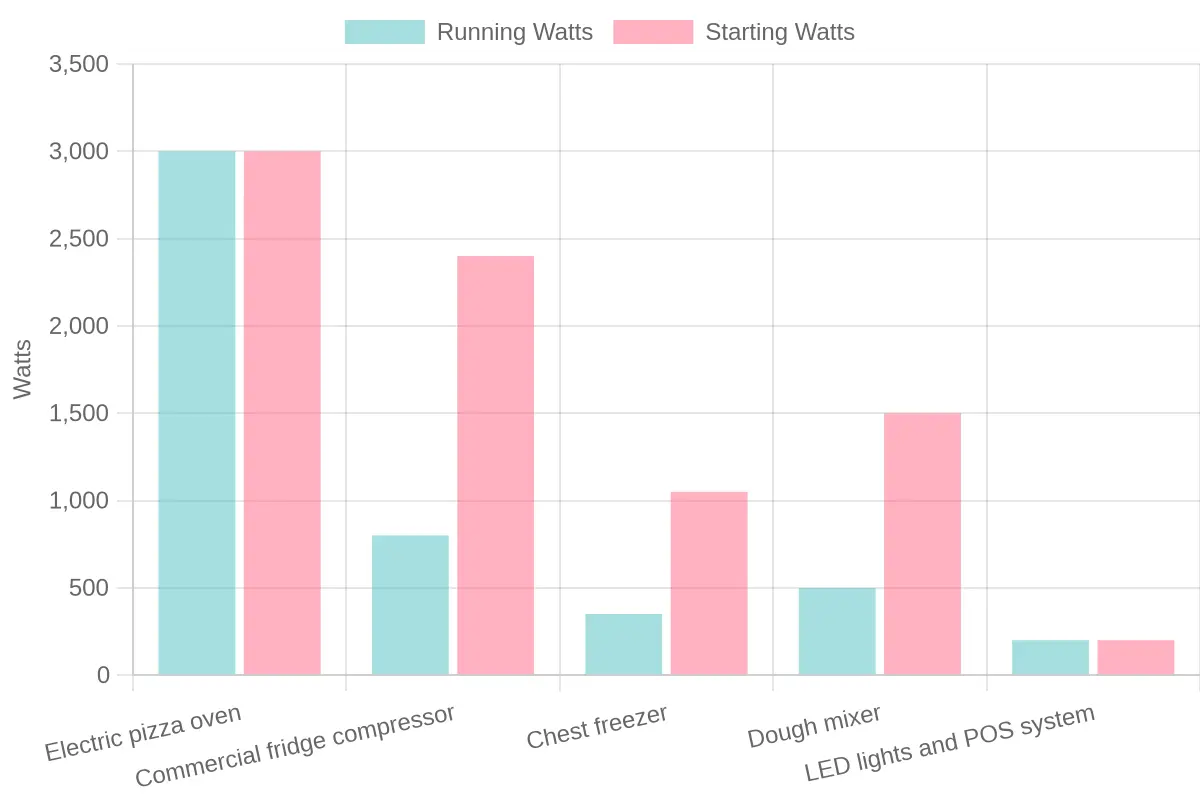
That initial jolt is called inrush current, and it can be two to three times higher than the running load. Here is the tricky part: the surge lasts only a fraction of a second, but it is usually the largest single demand your generator will ever face. A fridge that draws 800 watts while running might pull 2,400 watts for a split second when its compressor kicks on.
Running vs. Starting Watts at a Glance
| Equipment | Running Watts | Starting (Surge) Watts |
|---|---|---|
| Electric pizza oven | 3,000 | 3,000 |
| Commercial fridge compressor | 800 | 2,400 |
| Chest freezer | 350 | 1,050 |
| Dough mixer | 500 | 1,500 |
| LED lights + POS system | 200 | 200 |
| Total (everything at once) | 4,850 | 8,150 |
Notice that the surge total is nearly 70% higher than the running total. That gap is exactly where under-sized generators fail.
The Real-Life Scenario: Oven and Fridge Starting Together
Let us walk through what happens at 5:47 p.m. on a busy Friday.
Your electric pizza oven is already drawing its full 3,000 running watts. The fridge thermostat hits its target, the compressor cycles off, then a minute later it kicks back on. That restart is the killer: the compressor demands its 2,400-watt surge just as the oven and mixer are running.
Add a dough mixer at 500 watts and the chest freezer cycling on at 1,050 watts, and your peak demand can momentarily climb past 7,000 watts. A generator rated for 7,000 running watts might still trip, because its maximum output is being pushed to the very edge, and running a generator at its absolute ceiling wears it down fast.
This is why choosing the right gear matters as much as the size number on the box. Just as any trade depends on tools and equipment matched to the workload it carries, a pizza truck lives or dies by whether its equipment is genuinely built for the load it must handle.
How to Calculate Your True Generator Size
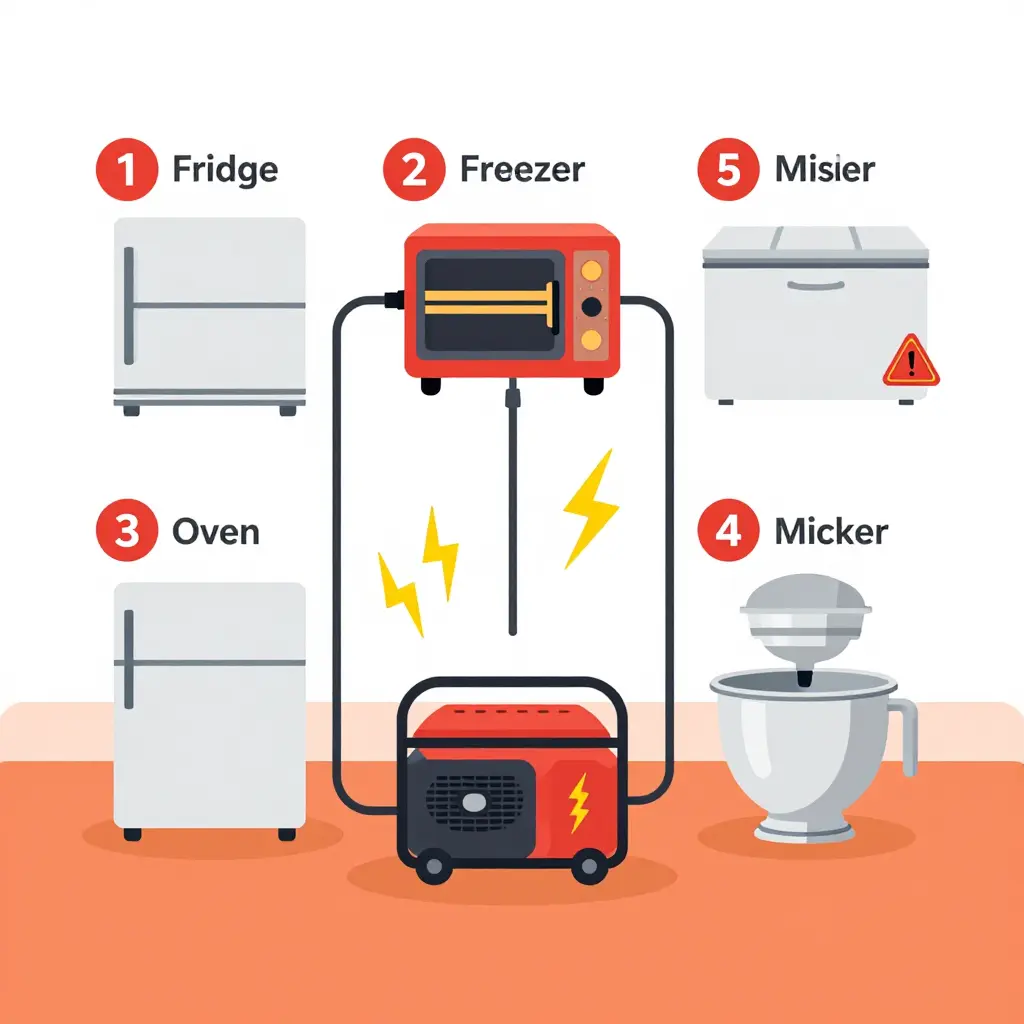
Sizing a generator is not about adding up every appliance’s running watts and calling it a day. Follow this sequence:
- List every appliance and its running watts.
- Add up all running watts for a base load.
- Identify the single largest starting wattage and add only that one, not all of them, to the base load.
- Add a 20-25% safety buffer for temperature, altitude, and aging.
Using the table above: base running load of 3,000 (oven) + 800 (fridge) + 350 (freezer) + 500 (mixer) + 200 (lights) = 4,850 watts. Add the largest surge (fridge at 2,400) = 7,250 watts, then apply a 25% buffer, which lands you near 9,000 watts of starting capacity.
The lesson: size for the surge, not the average.
Smart Strategies to Prevent Overload
You do not always need a bigger generator. Sometimes you need smarter operating habits.
Stagger Your Startup Sequence
Never let everything fire at once. Start the fridge and freezer first, let them settle, then bring the pizza oven online, and finally the dough mixer. Spreading the surge across a few minutes keeps any single moment under your generator’s ceiling.
Install Soft-Start Devices
Soft starters and hard-start kits ramp a compressor up gradually instead of slamming it with full inrush current. They can cut a fridge’s surge from 2,400 watts down to well under 1,000, a cheap upgrade with an outsized payoff.
Choose an Inverter Generator
Inverter generators produce cleaner power and handle delicate electronics, like your POS system and digital oven controls, far more gently. The advances in modern technology have made inverter models quieter and more fuel-efficient than the clunky units of a decade ago, which keeps your whole operation running reliably.
Adapt Your Setup to Your Environment
A generator that works flawlessly on a shaded, cool day can struggle in 100F heat, where every compressor works harder and every watt stretches further. Adapting your power setup to the environment you actually operate in, through venting, load placement, and airflow, prevents nasty surprises.
Planning Beats Panic
The best defense against a mid-service blackout is a power budget you build before you ever hit the road. Map out your peak-load scenario, write it down, and treat it like a checklist. It is the same discipline behind setting realistic, measurable operational targets that keep any small business steady under pressure.
The Bottom Line
When the oven and fridge start together, your generator faces its single toughest test of the day. Often the fix is smaller than a new generator: understand surge watts, stagger your startup, and size with a genuine safety margin. Do that, and you will keep the slices coming and the lights on.