
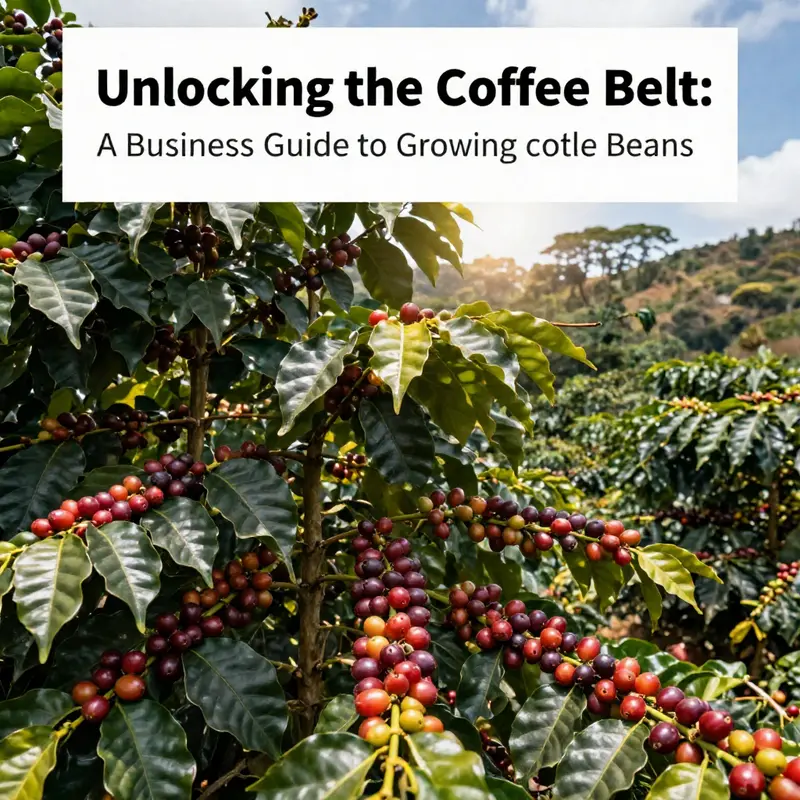
Coffee cultivation presents a unique opportunity for business owners in regions within the Coffee Belt—a tropical zone that provides the ideal conditions for growing high-quality beans. By understanding the essential factors that contribute to coffee’s success, such as climate, altitude, soil types, and prominent global growing regions, business operators can make informed decisions about establishing or expanding their coffee investments. Furthermore, an assessment of the economic viability of coffee farming will provide the necessary insights into the potential profitability of this venture. Each chapter delves into these critical aspects, guiding you through the essential criteria for growing coffee beans effectively.
null

null
Altitude as Flavor Architect: Elevation’s Crucial Role in Where Coffee Beans Thrive
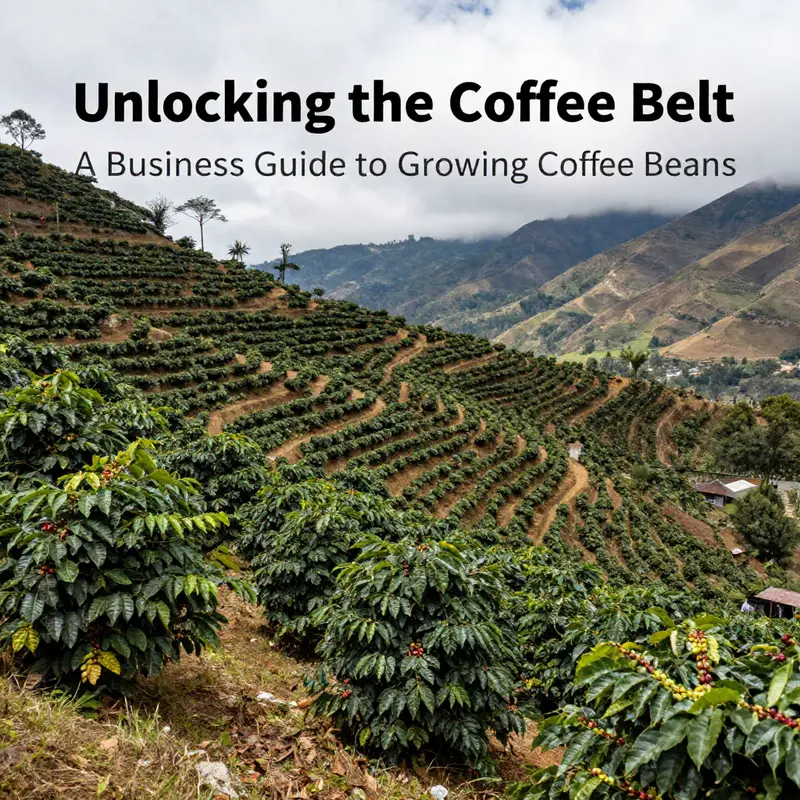
Altitude is more than a geographic label on a map. In the story of coffee, it acts as a secret architect, shaping every facet of the beans from their growth pace to the rhythm of flavors waiting to be unlocked in the cup. When people ask where coffee beans can be grown, the most precise answer starts with a contour line drawn in meters above sea level. Within the traditional, widely recognized belt that girds the equator, the opportunities for producing high-quality Arabica coffee are concentrated. Yet altitude alone does not guarantee success. It works in concert with climate stability, soil type, and rainfall, weaving a delicate tapestry that determines whether a plot of land yields beans with the bright acidity and nuanced sweetness that coffee enthusiasts chase. The elevation band most associated with premium coffee spans roughly from 800 to 2,000 meters. This range is more than a number; it embodies the physics of plant development. At these heights, cooler temperatures slow maturation. The slow grind of time allows sugars, acids, and aromatics to develop in more complex ways. The result is a cup whose aroma can be floral or fruity, whose brightness can cut through milk, and whose finish lingers with an uncommon clarity. It is no accident that famed coffee regions sit high. The elevation creates a microclimate where nights are cooler and days are not relentlessly hot, where the air is thin enough to ease transpiration yet not so thin as to stress the plant beyond its resilience. Growers who understand this balance learn to read the land not just by latitude or rainfall totals but by the way the hillside shapes sun angles, shade envelopes, and drainage pathways. In this sense, altitude becomes a practical teacher. It imposes limits and offers promises at the same time, guiding decisions about varietals, management practices, and harvest timing that can ultimately separate a good coffee from a memorable one.
The science behind this is often summarized as a trio: climate, elevation, and soil. Temperature interacts with altitude to create a diurnal rhythm that helps beans ripen with a more controlled accumulation of sugars and acids. Nights drop enough to slow metabolism, while days remain warm enough to nurture development. At 800 to 2,000 meters, the daily temperature swing tends to be moderate rather than extreme, giving the crop a steady cadence rather than a feverish sprint. The result is a slower, more deliberate maturation process. Slower maturation means more time for the coffee cherry to accumulate unique flavor compounds. The seed inside also thickens and densifies, producing beans that contribute to greater density in the cup. This density, in turn, is a proxy for quality in many roasts, affecting extraction and perceived balance during brewing. If flavor is the profile of a coffee, altitude helps script its tonal range, steering it toward brightness, winey acidity, or cocoa-like depth depending on the companion conditions of sunlight, rain, and soil.
But altitude does not act alone. Soil is a co-author of the flavor narrative, with drainage and mineral content playing as much a role as elevation. High-altitude regions often sit on volcanic or volcanic-ash-derived soils that drain well yet remain fertile. The texture of the soil, its organic matter, and its ability to hold moisture through a changing wet and dry season all influence how roots explore the ground and how nutrients are made available to developing beans. In the best highland farms, the combination of altitude and soil creates a fragile but productive balance. Too heavy a soil with poor drainage can keep roots waterlogged during heavy rains, eroding flavor development and raising disease risk. Too light an or overly sandy soil may exaggerate drought stress, constraining growth and reducing yield. The ideal is a well-drained, fertile, slightly acidic soil that supports robust root networks and encourages a steady supply of nutrients throughout the growing season.
Rainfall is another essential collaborator. Consistent rainfall, complemented by seasonal dry periods, supports a rhythm in tree physiology that aligns with the life cycle of the coffee cherry. In the highlands, rainfall distribution often integrates two distinct seasons: a wetter period that sustains flowering and fruit set, and a drier window that allows cherries to mature without excess disease pressure. The numbers often cited hover around 60 to 80 inches annually, with variations by region. When rainfall is steady but not excessive, the trees avoid stress while the fruit maintains a predictable development pace. Too little rain during key phases can stunt ripening, leading to uneven bean sizes and inconsistent flavors. Excessive rainfall, conversely, can increase the risk of mold and diseases that spoil both yield and quality. The altitude-driven microclimate helps buffer some of these effects by moderating temperatures and aiding drainage, but farmers still must manage shade, canopy density, and irrigation or rain-water harvesting to maintain the delicate balance between fruit set, maturation, and harvest timing.
Regionally, the emphasis on altitude is echoed across continents. Latin America hosts many renowned highland coffee belts in countries like Colombia, Guatemala, and Mexico, where rugged terrain and volcanic soils support elevated plantations. In Africa, Ethiopia and Kenya showcase terraces and plateaus that rise into the cooler moods of the atmosphere, creating profiles known for their floral aromas and vibrant acidity. Asia-Pacific regions—Indonesia’s upland zones, India’s high plateaus, and Yunnan in China—demonstrate that elevation can be a regional advantage even when landscapes vary widely. Yunnan, for example, has become China’s leading coffee region not only because it embraces altitude but also because its high-elevation terrain, rich mineral soils, and favorable microclimates enable both robust yields and quality-focused production. By 2025, Yunnan’s planted coffee area reached tens of thousands of hectares, producing a substantial annual volume and earning recognition on international markets. This demonstrates how elevation, when paired with thoughtful cultivation and processing, can translate into both local and global impact. It is worth noting, however, that attempts to grow coffee beans outside the traditional belt—without the proper altitude, climate, or soil conditions—tend to yield poorer quality and lower economic viability. The belt remains the most reliable framework for sustainable, profitable production, though ongoing experimentation and climate-resilience strategies keep expanding the practical boundaries of where coffee can be grown.
From a grower’s perspective, altitude suggests the kind of site to seek and the challenges to anticipate. Elevation informs decisions about which Arabica varietals to plant, how to shape shade canopies, and when to harvest before rains or cold snaps alter the crop. A location at 1,600 meters, for instance, can offer cool nights and dry mornings that preserve acidity while allowing sugars to accrue in a balanced fashion. Such conditions favor beans with crisp, lemony or bergamot-like notes, alongside deeper chocolate and caramel undertones that emerge with appropriate processing. Yet all this potential is tempered by practical realities: frost risk at higher elevations, the need for reliable water sources, and the economics of transporting harvests from rugged terraces to processing facilities. Therefore, farmers often make trade-offs. They select elevations that provide premium quality but manageable risk, and they invest in adaptive strategies such as shade management, soil enrichment, and drainage improvements to stabilize yields without sacrificing flavor integrity.
For anyone contemplating where to grow coffee beans, altitude answers some crucial questions: Will the climate support a reliable growing season with a distinct wet and dry pattern? Does the land offer soils that drain well and supply necessary minerals? Can shade and canopy management create favorable temperature and humidity conditions throughout the year? Elevation narrows the field to zones with the best chance of producing a consistent, high-quality product. It also helps explain why the global map of coffee is not random but carefully drawn along gradients of elevation, temperature, and moisture. Within those gradients, the most successful producers learn to read the land as a living system. They observe how small shifts—like a slightly different slope direction, a patch of older trees offering more shade, or a microclimate created by a nearby forest—can tilt flavor toward brighter fruit tones, nutty sweetness, or winey acidity. Such attentiveness is not just agronomy; it is a form of terroir-building, where altitude, soil, and water converge to define what the cup will ultimately taste like.
The deeper implication for the broader question of where to grow coffee beans is this: elevation helps define the upper limit of quality and the practical range of productivity. It is the factor that explains why some lands you might expect to yield coffee do so with modest flavor and limited economic viability, while others seem to unlock extraordinary potential with the same species. Within the Coffee Belt, the altitude range of 800–2,000 meters is a robust guideline that aligns with the physiological needs of Arabica and the sensory aspirations of specialty coffee. Regions like Yunnan illustrate how a highland footprint can translate into scale and recognition, but the tale remains consistent across continents: altitude shapes the plant’s life cycle, and that shaping translates into the cup’s character. In practice, this means choosing land where the hills, forest edges, soils, and rainfall patterns combine to sustain a comfortable rhythm for the coffee tree, one that mirrors the natural cadence of its environment. It is in this harmony that beans become more than agricultural product; they become a narrative of place, climate, and careful stewardship.
For readers seeking further detail on altitude requirements and other ideal growing conditions, the International Coffee Organization offers a comprehensive resource that situates elevation within a global framework of best practices and regional profiles: https://www.ico.org
Rooted in the Earth: How Soil Determines Where Coffee Beans Thrive and How to Read the Ground for Better Yields

The story of coffee begins long before the first bud breaks the surface. It starts in the soil, that quiet mediator between sun and root, where the health of every coffee tree is decided with each centimetre of humus and every breath of mineral-rich air. If climate sets the stage in the Coffee Belt, soil fills in the role of the support system that allows a delicate plant to flourish. To understand where you can grow coffee beans, you must listen to the ground itself. You must hear how the bed on which a plant sits speaks of drainage, texture, fertility, and pH, and how those traits shape the flavor potential of the beans that will someday bear the mark of a terroir as precise as a fingerprint. In this light, the soil is not a backdrop but the first and most intimate partner in the coffee’s journey from seed to cup. \n\nAmong the soil types most consistently praised for coffee cultivation, loamy soil stands as the gold standard. It is a composite smile of sand, silt, and clay, with just enough organic matter to offer both resilience and vitality. What makes loam so compelling for coffee is its balance: it drains well enough to prevent waterlogging but holds onto moisture enough to support steady growth through the dry season. It is loose enough for fine roots to explore and coarse enough to prevent compaction that would suffocate the shallow root systems that coffee trees rely on. Humus—the dark, organic component derived from decaying plant material—accumulates in loamy soils, feeding the microorganisms that unlock nutrients for the roots. In practical terms, a loamy bed provides a steady supply of nitrogen, phosphorus, and other trace elements while maintaining a microenvironment where roots can spread, oxygen can move, and water can cycle. \n\nFor growers aiming at sustainable practice, loamy soils offer a forgiving canvas. They respond well to organic amendments like compost and mulch, which add humus, improve structure, and boost microbial diversity. A soil in the sweet spot for coffee typically carries a relatively high organic matter content—roughly 2% to 5% is often cited as beneficial—without becoming so rich that the tree puts too much energy into vegetative growth at the expense of bean quality. The pH range around 5.5 to 6.5 is frequently recommended because it aligns with the nutrient availability that Arabica coffee plants preferentially absorb. Within this window, iron, magnesium, calcium, and other micronutrients become accessible to the plant’s roots, supporting steady growth and balanced development of the coffee cherries. \n\nVolcanic soils occupy a different but equally venerable place in the coffee narrative. These soils, especially when enriched by volcanic ash and other mineral deposits, resemble a natural fertilizer in disguise. They are often well-drained yet rich, with minerals that support robust microbial life and a steady supply of nutrients directly accessible to plant roots. The texture can vary—some volcanic soils are sandy-loam, others more clayey—but the unifying trait is their fertility and their ability to promote strong root systems without waterlogging. Volcanic soils also tend to support a slightly acidic environment that coffee plants relish, helping to keep nutrient availability in an optimal range. The drama of volcanic soil is felt not only in yield but in flavor potential. Coffees grown in these soils commonly exhibit depth, clarity, and a nuanced balance of sweetness and acidity. In the broad tapestry of the Coffee Belt, volcanic regions such as those scattered through parts of Indonesia, Central America, and East Africa show how geology can imprint a distinctive character on the beans. \n\nAn essential guiding principle for any grower is to respect the soil’s need for good drainage and air through the root zone. Coffee trees are shallow-rooted, with most uptake happening in the upper layers of soil. When a bed compacts or remains waterlogged, roots struggle to breathe, growth slows, and the plant’s resilience diminishes. In practice, this means avoiding heavy clay soils that remain wet for long periods unless they are amended with organic matter and structured with good drainage channels. It also means avoiding soils that drain too quickly and offer little nutrient retention; sand alone, while excellent at shedding water, often cannot supply the nutrient density coffee requires. The goal is a soil structure that supports both the delicate network of roots and the bustling microbial community that enables nutrient cycling. \n\nTo translate these soil principles into a location strategy, one must couple soil type with climate and altitude. A stable, warm temperature range with a defined wet and dry season meets the plant where it is happiest, but the actual bed the roots inhabit will determine how far the plant can be pushed toward the upper limits of yield and quality. The most acclaimed Arabica coffees typically come from higher elevations where temperatures are cooler. In those elevations, loamy soils or volcanic soils within the right pH and mineral balance become even more valuable. The combination of altitude, climate stability, and soil fertility fosters a longer bean development period, letting sugars and complex compounds accumulate to craft aromatic coffees with bright acidity and nuanced sweetness. In this light, soil is not merely a container; it is an active partner in achieving flavor complexity, particularly when the farmer combines soil stewardship with shade management, appropriate irrigation, and careful fertilization. \n\nThere is also a pragmatic lesson embedded in these soil considerations. While the belt provides the broad geographic permission to grow coffee beans, the choice of soil type and its management often dictates whether a given plot is commercially viable. Outside the belt, attempts at coffee cultivation may be technically possible but economically impractical because the soil and climate do not harmonize with the plant’s needs or the market’s expectations for quality and consistency. Even within the belt, some soils demand substantial amendment or structured irrigation to meet production and quality goals. The capacity to build and maintain soil health through compost, cover crops, and strategic organic matter additions will determine sustainable yields over time. The ground, in other words, rewards long-term thinking and patient improvement as much as it rewards climate and altitude. \n\nIn moving from theory to field practice, a grower learns to read the soil as a living map of potential. A loamy bed tells you you can invest in steady, medium-density input strategies that keep the soil alive and the trees thriving. A volcanic bed invites you to exploit a natural fertilizer narrative, while guarding drainage and preventing abrupt pH shifts that could perturb nutrient uptake. The habit of testing soils—pH, texture, organic matter, and cation exchange capacity—becomes a daily routine, not a weekend chore. Regular soil tests can reveal when a bed is drifting toward a nutrient imbalance or when organic matter is depleting, prompting timely interventions. In turn, these interventions nurture stronger trees, better resilience to drought, and more consistent yields from season to season. \n\nThe practical upshot for the reader who is imagining where to plant coffee beans is straightforward but nuanced. The ideal bed falls within the defined coffee belt and aligns with a climate that supports a stable, gentle rhythm of wet and dry seasons. Within that frame, loamy soils are the most universally accommodating, balancing drainage, fertility, and structure in a way that supports both robust plant growth and high bean quality. Volcanic soils, when present, add an extra layer of flavor potential through mineral richness and favorable acidity, but they still require careful management to preserve drainage and prevent nutrient leaching. Whether you choose a site dominated by loam or one that sits atop volcanic ash, the shared objective remains clear: create a thriving root zone that stays well-aerated, never waterlogged, and rich in organic matter. \n\nAs you translate this soil knowledge into a practical plan, you’re reminded that the ground itself is a guide. It reveals where coffee thrives, not merely where it survives. The best-growing spots are those where soil structure and fertility respond to attentive management, where organic matter is replenished, where pH remains within the golden window, and where the plant’s shallow roots can explore a welcoming, well-aerated matrix of minerals and microbes. In that sense, soil types become a language—a way of describing land that tells you how to partner with nature to produce beans capable of defining a region’s identity. The ground, if treated with respect, will turn a plot into a micro-terroir, and a micro-terroir into a cup that offers the story of place in every sip. \n\nFor readers seeking a consolidated reference to these soil-improvement practices and to situate soil choice within the broader conversation about sustainable coffee production, consult the guiding resources that frame coffee growing within a global context. A reputable external resource provides expansive profiles of growing conditions and regional characteristics, helping map the practical steps from soil to cup. You can explore more at the official source that aggregates current knowledge on coffee cultivation and regional profiles: https://www.coffee.org/ \n\nAs the argument for soil literacy deepens, it becomes clear that the ground beneath the coffee tree is not simply a substrate but a partner in the quest to grow beans that can travel the world. The right soil supports a healthy canopy, resilient roots, and a steady rhythm of nutrient exchange. It aligns with climate and altitude to shape the bean’s development timeline, the concentration of sugars, and the clarity of acidity. In the end, the question of where you can grow coffee beans is answered not by a single latitude line alone but by a composite portrait of land: the texture that invites roots to breathe, the mineral inventory that nourishes growth, and the organic matter that fuels life underground. It is this portrait—subtle, patient, and demanding—that yields coffee with character, complexity, and a sense of place that can travel from hillside to cup across continents.
Geography of Coffee: The Coffee Belt and Its Regions
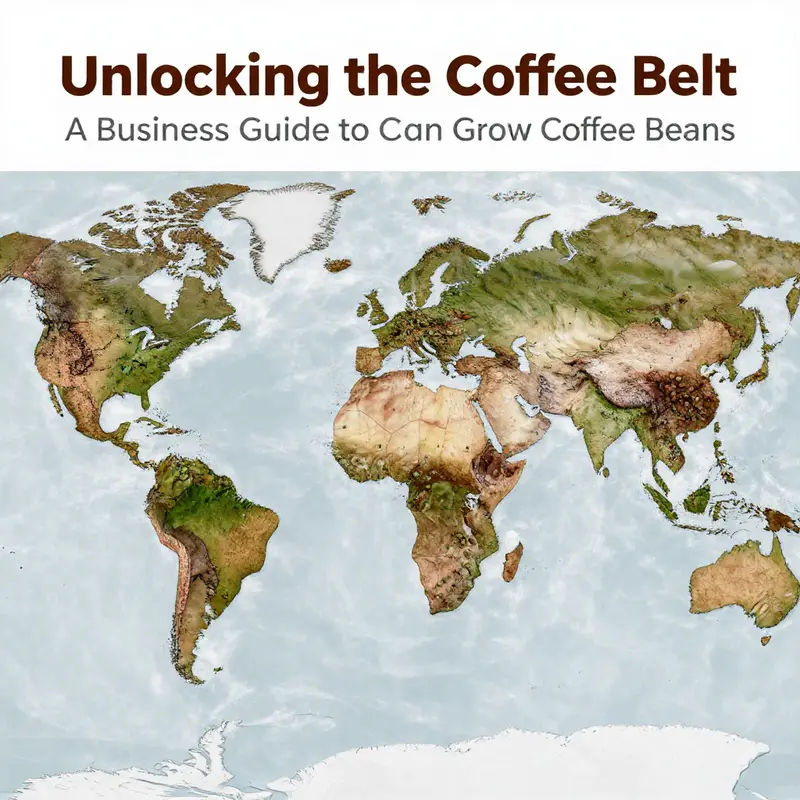
Coffee beans flourish best where climate, altitude, soil, and sunlight align in a narrow band near the equator, roughly 25 degrees north to 25 degrees south. This is the Coffee Belt, a belt that encompasses many of the world’s premier origin regions. The temperature range is warm but not scorching: day temperatures often in the 60s to 70s Fahrenheit (15 to 24 degrees Celsius), with diurnal cooling at higher elevations that slows maturation and helps develop aroma and acidity. Rainfall is steady but with a pronounced dry window to allow cherries to mature. Altitude matters: Arabica thrives at elevations from about 900 to 1800 meters above sea level, where cooler nights slow development and concentrate sweetness and complexity. The soil matters too: well-drained, mineral-rich soils—often volcanic—support strong root systems and nuanced flavors. The Belt is not simply about hot weather; it is a confluence of terroir factors that yields a spectrum of cup profiles across regions. Latin America, Africa, and the Asia-Pacific each contribute distinct expressions, yet all share a reliance on reliable climate, manageable rainfall, and investment in care and processing. Outside the Belt, cultivation is possible but frequently less stable in yield and flavor. As climate patterns shift, growers adapt with cultivar choices, shade, and water management, but the central idea remains: place shapes flavor, and the Belt remains the most reliable geographic canvas for high-quality coffee.
Profit in the Coffee Belt: How Geography, Technology, and Sustainability Define Where Beans Make Business Sense

Where you grow coffee beans is as much an economic decision as a climatic one. The Coffee Belt, the band of tropical and subtropical latitudes that hugs the equator, has long defined the places where farmers can reliably produce high-quality beans at commercial scales. It is within roughly 25 degrees north to 25 degrees south that climate, altitude, soil, and sunlight align to create what growers call the ideal terroir for coffee. Yet geographic suitability alone does not guarantee profitability. The chapter that follows traces how economic viability emerges from a combination of traditional adaptation, modern processing innovations, and deliberate choices about farming systems. It is a narrative that starts with land and climate, then moves through capital, technology, and market dynamics, and ends in resilience. In that journey, the story of today’s coffee is as much about smarter drying, smarter farming, and smarter governance as it is about altitude and rainfall. Geographers may point to maps of the belt; economists point to balance sheets. For growers seeking a practical path, both maps and models matter, because the same climate that lends bean quality can also magnify risks if water, soil, and labor markets fail to keep pace with changing demand and weather patterns.
The physical conditions that define the belt have not changed in principle, even as climates shift. Stable temperatures within a narrow band, distinct wet and dry seasons, and adequate rainfall—roughly 60 to 80 inches per year—provide the canvas on which coffee trees paint their flavors. Elevation matters too. Arabica coffee, which is prized for nuanced aroma and acidity, typically thrives at 900 to 1,800 meters above sea level. Higher elevations slow bean development, allowing sugars and organic compounds to integrate in ways that yield more complex cup profiles. Farmers in Latin America, Africa, and Asia have long weighted altitude, soil type, and microclimate into their planting decisions because those factors directly influence quality, market price, and, ultimately, revenue. Within this frame, the belt remains the most economically efficient region for large-scale specialty coffee production, with notable exceptions and exceptions to the rule that nevertheless illustrate broader truths.
Innovation, particularly in processing and drying, has begun to tilt the economics of coffee farming in meaningful ways. Drying is not merely a precursor to roasting; it is a decisive step that determines the final bean quality that buyers price. Recent analyses highlight a drying technology that uses dehydrated air to replace traditional yard drying. In practice, this approach reduces split and broken beans, preserves bean integrity, and improves sieve retention in No. 17 grading, a key quality benchmark for many buyers. The economic implications of such a shift are striking. A study evaluating this drying method found a 12.11 percent higher market price for coffee produced with dehydrated-air drying, a quick and favorable payback period of about 2.27 years, and a total potential return around US$2.49 million in the studied scenario. The analysis also demonstrated a very high level of technical desirability—nearly 99 percent of outcomes aligned with optimal performance—and highlighted the elimination of the need for large, concrete-drying yards as an added economic and environmental benefit. This is not a minor operational tweak; it is a technology that can reframe a farm’s cash flow, reduce risk from weather variability, and lengthen the economic life of the plant through higher-quality, consistently graded beans.
When we widen the lens beyond processing to the broader system, the economics become more nuanced but no less compelling. Climate change increasingly threatens traditional suitability across substantial portions of the belt by altering rainfall patterns, increasing drought risk, and shifting pest pressures. The 2025 Columbia University Center on Sustainable Investment report underscores that some regions could see yields decline and bean quality degrade if swift adaptation does not occur. Yet climate risk can be mitigated through sustainable farming practices that also align with global development aspirations. Coffee-based agroforestry systems, for example, blend shade-grown trees with annual crops, creating microclimates that buffer against temperature swings and weather extremes while maintaining or boosting soil health. These systems also advance SDGs by preserving biodiversity, improving livelihoods, and fostering long-term resilience. In practice, farmers who combine shade management with diversified income streams—intercropping, microprocessing, or value-added products—tend to weather shocks better and sustain higher levels of productivity over time.
Economic efficiency at the farm level is another pillar of viability. A 2023 study in Colombia showed that the average economic efficiency of coffee farmers hovered around 89.6 percent, suggesting that many growers operate near their production frontier but still have room to push further along it. The implication is not merely that some farmers are underperforming; it is that modest improvements in management, organization, and technology can yield outsized returns. In East Africa, national development strategies recognize coffee as a driver of employment and GDP and, crucially, as a pathway to engaging youth in rural economies. Policymakers are experimenting with capital access, training, and market linkages to move farmers from subsistence-scale production toward more formalized, export-oriented operations. These measures matter because the economic value chain—cultivation, processing, transport, and marketing—depends on reliable access to credit, knowledge of quality standards, and stable demand.
If we pause at the regional mosaic, the belt’s diversity becomes evident. Latin America has Brazil’s vast scale and Colombia’s balance of body and acidity; Central American and Mexican farms often emphasize consistency and bright, fruity notes. Africa contributes some of the world’s most distinctive floral profiles from Ethiopia and vibrant citrus notes from Kenya, while Asia-Pacific offers a spectrum from the full-bodied Mandheling profile of Indonesia to the more delicate layers found in Yunnan’s higher-altitude plots. The Yunnan example is particularly instructive in recent years. China’s ascent within the belt region—driven by high-altitude topography, volcanic soils, and favorable climate—has elevated it to become the country’s leading producer in terms of area, yield, and agricultural output. By 2025, Yunnan reported nearly a million hectares of coffee planted and about 170,000 tons produced annually, with exports surpassing tens of thousands of tons to European and North American markets. That success is not simply about planting more trees; it is about building an integrated value chain that supports quality production, adheres to international standards, and cultivates trust with buyers abroad. It also speaks to a broader truth: economic viability is increasingly tied to the ability to manage the entire lifecycle of the bean—from nursery to drying, from farm gate to port—through processes that reduce waste, enhance quality, and tap into global demand.
Nevertheless, growth outside the traditional belt remains a compelling, though often costlier, calculation. Attempts to scale coffee in more marginal climates can yield inferior bean quality and lower yields, undermining the economics even when the crop can technically mature. The modern narrative, then, is not simply about pushing beans into new latitudes but about making the belt work more efficiently and equitably. That means investing in better drying methods, adopting sustainable practices that protect soils and water resources, and strengthening the market institutions that connect smallholders to global buyers. It also means careful site selection within the belt—choosing elevations and microclimates that complement processing capabilities and logistics, while considering local labor dynamics and energy costs. The result is a more resilient, more profitable model of coffee farming that can scale without sacrificing the distinctive flavors that define different regions.
All of this points to a practical takeaway for farmers and investors: the economic viability of growing coffee beans is as much about intelligent management as about climate. Innovations in processing, particularly drying, can compress payback periods and lift farm incomes while maintaining or improving quality. Sustainable systems like agroforestry help buffer against climate shocks and align farming with global sustainability goals. At the same time, regional leaders within the belt—Brazil, Colombia, Ethiopia, Indonesia, and Yunnan—demonstrate that a well-run system, supported by strong markets and policy attention, can deliver significant economic returns even as environmental pressures intensify. The path forward for growers, communities, and nations lies in embracing both the agronomic advantages of the belt and the technological and governance innovations that turn those advantages into durable profitability. For those who seek deeper technical and economic insights into drying and profitability, the study on dehydrated-air drying provides a rigorous, data-driven perspective that complements the broader market and climate discussions: it illustrates how a specific processing improvement translates into tangible economic gains and faster capital recovery. External reference: https://www.mdpi.com/2077-0472/13/3/155
Final thoughts
Understanding where you can grow coffee beans is essential for business owners looking to enter or expand within the coffee industry. By grasping the critical climate conditions, altitude requirements, suitable soil types, and the key regions around the globe where coffee thrives, investors can make insightful decisions. Furthermore, assessing the economic viability reinforces the potential for sustainable profitability in coffee cultivation. As you consider embarking on this coffee-growing venture, remember that aligning your strategy with these fundamental elements is crucial for long-term success.