
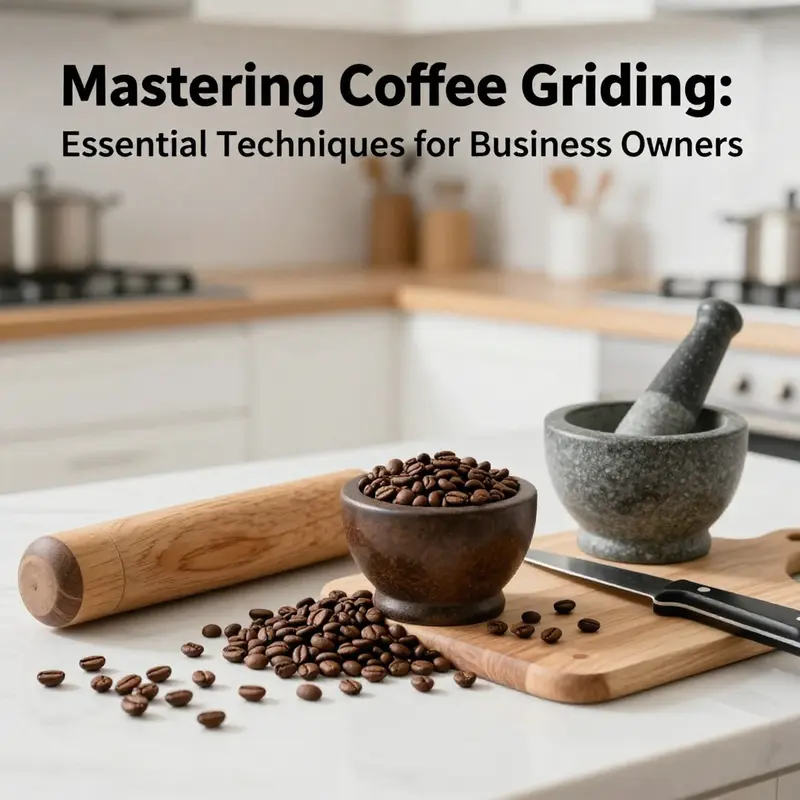
For coffee enthusiasts and business owners alike, freshly ground coffee beans can dramatically enhance the flavor and aroma of a brew. However, not everyone has a dedicated coffee grinder at their disposal. Understanding how to grind coffee beans without a grinder is invaluable, especially for those running a cafe or similar establishment where top-notch coffee is a hallmark of quality. This guide explores several accessible methods: employing a rolling pin and plastic bag for medium coarse grinds perfect for pour-over and filter coffee, utilizing a mortar and pestle for coarse grinds ideal for French press, and leveraging a knife and cutting board in emergencies to achieve a fine grind for espresso. Each chapter will unpack these methods, ensuring you can produce quality coffee grounds no matter your resources.
From Pantry Tools to Fresh Grounds: Mastering the Rolling Pin and Plastic Bag Grind Without a Grinder

Rolling Pin and Plastic Bag Method is a practical way to grind beans when a burr or blade grinder is not available. It taps into the sensory and manual control that coffee lovers often crave and keeps flavors bright by grinding close to the moment of brewing.
Start with the right quantities. Most days you can work with about 30 to 50 grams of beans depending on the number of cups you want. For pour over or filter style brews aim for a texture similar to coarse sand that lets water pass without clogging the filter. For espresso like results the grind will need to be much finer, but true espresso level grind is hard to reach with manual tools.
The tool setup is simple. Use a thick sealable plastic bag large enough to hold the beans and leave room to maneuver. A sturdy freezer bag resists tearing and the thicker plastic helps protect against punctures. Put roughly 30 to 50 grams of beans in the bag. Squeeze out as much air as possible and seal firmly. For extra safety, consider a second bag.
Lay the bag flat on a solid surface such as a cutting board or countertop. This creates a stable stage for grinding and keeps the bag from sliding.
The grinding action has two moves. First apply vertical pressure with a rolling pin to break the beans into smaller pieces. The goal is not a powder but a fragmentation that can be shaped in the next step. Then switch to a side to side rolling motion with the flat side of the pin. Roll across the bag with steady pressure, keeping wrists aligned and the forearm locked for control. If larger fragments cling to the bag you can tap them lightly with the end of the pin to break them down.
Periodically check the grounds. Pause, open the bag slightly, and look for even size particles rather than a mix of large and small bits. If you see clumps, return to the rolling motion and apply incremental pressure. The idea is to prevent over grinding and preserve aroma.
Sifting can help. Once you feel you have a reasonable size, pour the grounds through a fine sieve to separate oversized pieces and return them to the bag for another pass. If you do not have a sieve you can use the bag edges by gently tapping to reveal larger pieces and re run them. A heavier rolling pin makes it easier to apply even pressure with less wrist strain.
Texture targets you might pursue include coarse sand for pour over and something closer to a light flour for very fine techniques. The key is to favor consistency and control rather than chasing a perfect match to a commercial grind.
Beyond the rolling pin you can adapt with a glass bottle or a mortar and pestle. A wine bottle with a broad base can provide a stable pressing surface. The mortar and pestle can give a gentle fragmentation and minimal heat rise. These tools keep the method approachable even when gear is scarce.
Practical boundaries matter. You should not expect true espresso level fineness and full extraction from this method. If your brew is pour over or filter you can still achieve a satisfying result by grinding evenly and keeping strokes steady. This approach rewards time and patience and becomes a small ritual that fits a busy kitchen.
Final steps include transferring the grounds to an airtight container away from light and heat. If you can, grind immediately before brewing to maximize aroma. If you must store grounds, keep them in a cool dark place for a short time in a sealed container.
As a quick reference, relate texture to brew method: coarse sand for pour over, medium for moka style, and finer options for stronger brews while understanding the limits of a non burr tool. The rolling pin method invites you to experiment with bag thickness weight and stroke pace as you learn how each variable affects the final cup.
This method is a compact craft that lives at the intersection of resourcefulness and taste, turning everyday tools into a dependable path to flavorful coffee when a grinder is not available.
Mortar & Pestle Mastery: Hand-ground Coffee Without a Grinder, with Purpose and Patience

The wooden spoon and the electric motor sit in two different worlds of coffee preparation, yet the mortar and pestle sits somewhere in between—an ancient, tactile bridge between ritual and practicality. When a grinder is unavailable, this duo offers more than a workaround. It invites a slower, more deliberate relationship with the bean, where aroma, texture, and timing mingle with effort to shape the cup. Grounding coffee with a mortar and pestle is less a shortcut and more a craft. It rewards attention to detail and a willingness to engage with the bean in its most intimate form. The method suits a minimalist mindset and can be remarkably satisfying for those who value hands-on processes as part of the brew itself. In the quiet counter space of a kitchen, a stone mortar becomes a small workshop, and the pestle is the instrument that translates whole beans into a powder whose character carries the fingerprint of your effort as surely as any modern device could.
Choosing the right equipment matters almost as much as choosing the beans themselves. A stone or ceramic mortar with a smooth interior and a sturdy pestle is ideal. The goal is to crush and break the beans without introducing metallic flavors or chipping the surface—a risk with rough or improper materials. Stone and ceramic surfaces provide the necessary hardness and texture without imparting an off-flavor. The urge to push aggressively can tempt you to rush, but this is a method that rewards patience. The interior surface should be kept dry; moisture invites clumping and makes it harder to achieve consistent particle sizes. The mortar’s depth should allow you to work in small batches without spillage, and the pestle should fit comfortably in your hand, enabling you to apply even, controlled pressure.
If the kitchen is a theatre, the mortar and pestle stage is a small one. You begin with a measured amount of beans, typically a batch that aligns with the brewing method you intend to use. The guidance here is conservative—about 5 to 10 grams per grind session—so you can observe how the beans respond to the pressure and circular motion without losing track of texture. Grinding in small batches helps keep heat at bay, which in turn preserves delicate aromatics that can volatilize with lingering friction. In a brief, non-technical sense, you are trying to coax the bean’s oils into the grind as you would coax a melody from a string. The process requires rhythm and consistency; you should aim for uniform pressure and deliberate movement rather than frantic, rapid action.
The mechanics are simple but precise. Start with the beans in the mortar and apply a steady circular motion with the pestle, then add a light pressing force to compact the fragments and encourage further crushing. The idea is to create a sequence where the beans are repeatedly broken into smaller pieces through a combination of shear and pressure. The circular motions should be controlled, not wild; you want to guide the fragments toward a gradual, even fragmentation rather than shattering them into highly uneven dust. As you work, rotate the mortar slowly to ensure no area is overstressed. This is the moment where texture begins to reveal itself: at first the beans crack and split, then they start to resemble a rough powder with occasional larger particles sprinkled through.
What counts as a good grind when you are using this tool is less about perfect uniformity and more about practical consistency. In the realm of coffee brewing, the particle size distribution is critical because it determines extraction dynamics. For a standard American drip or a light-filtered technique, you want a grind that sits in the realm of medium to medium-coarse—think granules that feel like rough sea salt when held between fingers, with enough variation to keep extraction balanced. If you are aiming for a stronger shot or a more concentrated brew, you may try a finer texture, but be aware that the mortar and pestle lacks the fidelity of a burr grinder; achieving espresso-like fineness will be labor-intensive and may still leave some inconsistency. The key is to align your grind with your brewing method while acknowledging the method’s natural constraints.
To improve uniformity, adopt a few simple practices that echo the careful pacing of a craftsman. Grind in batches if needed, not in a single, large handful. After a round of grinding, inspect the powder visually and by feel. You are looking for a powder that feels uniformly coarse to fine, with no glaring pockets of coarse chunks or dust that looks deceptively soft yet behaves unpredictably in water. If you encounter a handful of larger pieces, return them to the mortar and grind again, taking a moment to reassess your pressure and motion. The act of turning and re-checking is not a chore but a participation in quality control, a ritual of ensuring that your effort translates into a predictable brew.
The heat generated by grinding is a real consideration, even when the work is manual. The friction between the pestle and the stone warms the particles, and this warmth can nudge aromatic oils toward evaporation, subtly tinting the flavor profile. This is not a dramatic loss, but it is a reminder that the process matters. To mitigate this, keep the sessions brief and dispersed, rub the mortar and pestle dry between batches to prevent damp clumps from forming, and avoid grinding for long stretches in one go. With careful pacing, you preserve more of the coffee’s nuanced notes and, importantly, you maintain a comfortable rhythm for your hands.
Once you achieve a grind that suits your brew, you should consider how to use it most effectively. Freshness matters more with this method than with most; the moment you have ground the beans, you should be ready to brew. The volatility of aromatics diminishes quickly after grinding, so timing between grinding and brewing should be minimized. For pour-over and similar filter methods, the optimized texture you have reached should permit a steady, even extraction as hot water flows through the grounds. The grind acts as a sieve, shaping how quickly water dissolves desirable compounds while giving you a balanced cup with clarity and aroma. In this sense, the mortar and pestle demands a shift in how you plan your workflow: it rewards deliberate timing, a calm pace, and a readiness to adapt to the texture you produce rather than chasing a perfectly uniform size.
The ritual of grinding by hand also invites a more nuanced approach to batch management. If you are preparing coffee for multiple cups or different brewing styles, you can space out the batches and reassess texture after each grind. A key tactic is to treat the process as incremental micro-grinding: grind a small amount, test its consistency, and then decide whether to grind again. This approach reduces the risk of over-grinding a batch and encourages you to tailor the grind to the final extraction method rather than forcing a single texture to serve all needs. The practice becomes a conversation with your equipment, your beans, and the moment of brew itself, rather than a mechanical routine. In that sense, the mortar and pestle becomes a living tool, one that invites you to listen to the coffee rather than merely perform a task.
The sensory side of the method is worth highlighting. After grinding, lift a small portion of the grounds toward your nose. You should notice a bright, lively aroma that suggests the oils have remained accessible. If the scent seems muted or stale, it can be a cue that more delicate notes have faded—a reminder that heat and time impact aroma. A quick sniff can also inform your intuition about grind texture: a powder that clings to your fingers or feels unusually dry may indicate over-drying or under-grinding. Scent, texture, and the light, tactile cues of the grounds become part of the evaluation process that guides your next batch. You are not only assessing particle size but also the state of the bean’s aromatic potential, and that sensory feedback feeds back into the craft of the grind.
A practical corollary to this method is its adaptability in constrained environments. In a camp setting or when electricity is scarce, the mortar and pestle shines as a portable, reliable solution. The stones in your pocket can become a means of sustaining the ritual of coffee, even when the modern conveniences are out of reach. You can imagine a quiet campsite, a sturdy stone vessel in a foldable wooden arm, and the pestle tracing patient circles as dawn light filters over the horizon. The grounds that emerge from this ritual do not pretend to be indistinguishable from those produced by high-end equipment, yet they carry something equally valuable: a direct lineage to the bean’s origin, a trace of your own pace, and a coffee that invites you to slow down and notice. The potential for connection, aroma, and flavor is at the heart of this method, not solely at the mercy of a machine.
In the broader arc of the chapter, it is important to recognize the limits and the opportunities of the mortar and pestle. It is not a universal replacement for every grind you might need; it cannot, in most cases, produce the precise, homogeneous fine texture needed for commercial espresso extraction. Yet it offers a remarkable degree of control over texture, a tactile engagement with the grind, and an intimate feel for the bean. For many enthusiasts, the method becomes a gateway to understanding grind size, extraction science, and flavor more deeply than a quick pulse of a blade or a dial on a grinder would permit. It invites experimentation, reflection, and a humility before the bean that aligns well with the craft of brewing at its best. If you are exploring coffee as a sensory practice rather than just a daily routine, this method can become a foundation for a more thoughtful, personalized coffee ritual that respects both the bean and the maker.
To summarize the through-line of the mortar and pestle approach: select a smooth, durable mortar and a comfortable pestle; grind in small batches to manage heat and promote uniformity; use circular grinding with consistent pressure and occasional turning of the contents; inspect texture and adjust your technique accordingly; grind immediately before brewing to maximize aroma and flavor. These steps, though simple, create a disciplined rhythm that honors the bean’s integrity while still delivering a cup that can stand up to your preferred method of extraction. If other chapters in this article describe different non-grinder methods for various brewing styles, the mortar and pestle chapter sits alongside them as a reminder that the path to a satisfying cup is not a single tool but a spectrum of practices, each with its own virtues and constraints. The central principle remains constant: fresh, properly prepared grounds dramatically elevate the cup, and you can achieve meaningful results even without a modern grinder when you couple technique, patience, and a mindful approach to heat and texture.
For readers seeking a broader perspective on similar non-mechanical methods, this chapter echoes a tradition that values hands-on engagement with coffee. The mortar and pestle method stands among other improvised approaches as a testament to resourcefulness and craft. It shows that, with careful attention to the texture of the grounds and the timing of the brew, you can extract a revealing profile from beans using only the tools already at hand. The aromatic potential is not sacrificed in the name of convenience; rather, it becomes a measure of how well you honor the bean’s natural complexity through thoughtful technique. While it requires time, effort, and discipline, it also offers a distinctive satisfaction—one that comes from knowing you contributed to the cup with your own hands, from the moment you opened the bag of beans to the moment you pressed the last drop through the filter.
As you transition from the sensation of grinding with stone to the moment the hot water begins to meet the grounds, consider how this method shapes your mental map of coffee making. It invites you to slow down, to measure, to feel, and to gauge extraction by sight, scent, and taste. It is a reminder that there is a tactile dimension to coffee that modern devices can seldom capture. And if you ever doubt the value of a hands-on grind, recall the moment when the grounds released their oils and the aroma rose with the first touch of steam—an experience that no pre-ground coffee can replicate. The mortar and pestle, then, becomes not a mere workaround but a conduit to a different, perhaps more intimate, relationship with coffee. The next time you find yourself without a grinder, you may discover that this ancient, patient method yields not only a workable grind but a story you can carry into every brew you make thereafter.
External resource: For a broader overview of grinding coffee beans without a grinder, including other non-electric methods, see The Spruce Eats. https://www.thespruceeats.com/grind-coffee-beans-without-grinder-1879619
Edge of Brew: Mastering Knife-and-Cutting-Board Grinding When No Grinder Is At Hand

A good cup of coffee begins before the aroma escapes the mug, and sometimes the barrier between a lively morning and a dull, flat brew is simply the absence of a coffee grinder. In those moments, a kitchen drawer, a sturdy cutting board, and a well-used knife can become an improvised grinder that turns whole beans into usable grounds. This isn’t about chasing perfection with a single, flawless tool. It’s about embracing a practical, hands-on approach that respects the beans and honors the ritual of brewing. The knife-and-cutting-board method is not meant to replace purpose-built equipment in your daily routine. It’s a reliable emergency technique, a test of patience and control, and a reminder that the essence of coffee—freshness, aroma, and balance—can be preserved even when a dedicated grinder isn’t available. If you keep your expectations anchored in realism, this approach can yield surprisingly decent results for a range of brewing styles, from a quick pour-over to a sturdy French press, provided you adjust your technique and mindset accordingly.
Preparation is the quiet door to a successful grind. Place your coffee beans on a clean, dry cutting board. If you want to minimize mess and maintain a semblance of uniformity, consider first sealing a portion of beans in a small plastic bag or wrapping them in parchment paper. The goal is to keep the beans contained so they don’t roll away and so ground dust doesn’t scatter across the counter. A sealed bag can also shield the interior of your workspace from the scent of freshly cracked coffee, which some people enjoy and others find distracting. The cutting board itself should be stable, with a dry surface, and ideally non-slip. If the board slides under your weight, place a damp towel underneath to keep it from shifting as you work. The knife should be a sturdy, non-serrated chef’s blade with a flat, broad blade that sits flush against the beans. A dull knife is a hazard and a poor grinder, so ensure the blade is sharp enough to bite into the beans without excessive force.
The technique itself rests on a simple principle: apply steady, downward pressure to crush the beans into fragments, then broaden the contact area by sliding and rotating the blade so the entire surface of the pile is engaged. Start by placing a small handful of beans at a time on the board. It’s tempting to load up more beans to speed the process, but a crowded surface encourages uneven grinding and can cause the blade to slip. With the flat side of the knife laid gently on top of the beans, press down with your hand and wrist, not just your forearm. The goal is to crush rather than chop, to invite a crumble rather than a jagged break. Move the blade slightly to cover different sections of the pile, then rotate the pile and repeat. The motion should resemble a careful, measured crushing rather than a rapid hacking action. Each pass reduces larger chunks into smaller fragments and gradually creates a mixture of particle sizes that resembles coarse sand or, for finer work, a more powdery texture.
Uniformity in particle size is the elusive prize here. The reality is that a knife can’t magically replicate the uniform grind produced by a burr grinder or even a high-powered blade grinder. You’ll likely end up with a range of particles from powdery fines to larger shards. The larger issue is how these particles behave during extraction. Fines extract quickly and can overdraw the brew, yielding bitterness and astringency if left unchecked. Coarser fragments, on the other hand, extract more slowly and risk under-extraction and a weak cup if the grind is too coarse. This is why the knife method shines most when you’re aiming for a brew that tolerates some variability, such as a pour-over with a forgiving bloom or a well-tuned French press where the immersion duration can compensate for unevenness. It’s also why you may want to sift after grinding.
Sifting is a quiet, almost meditative step that improves consistency without requiring any new tools. If you have a fine-mesh sieve or flour sifter, pass the grounds through and catch the larger pieces. Return those chunks to the blade for another round of crushing. The process resembles a manual, low-tech form of circular grinding: you’re not creating perfectly uniform particles, but you are actively reducing the variability by reworking the coarser bits and returning the fine dust to the mix. If you don’t have a sieve handy, you can still use the knife method with a light touch. The key is to test the grounds by a small test brew and gauge how the extraction behaves. The water will tell you whether you’re closer to a medium-coarse range fit for a filter method, or whether you’re leaning toward something more on the fine side for a richer espresso-like result, though the latter will require careful handling to avoid scorching heat and uneven pressure.
Fast guidance is rarely the friend of quality, and the knife method underscores this truth. It’s not a sprint; it’s a careful, disciplined practice. Expect the process to take longer than a quick spin in a grinder. The first attempt will likely produce a mixture of particle sizes, and that is okay as long as you adjust your expectations for the brew. If you’re making pour-over, the targeted grind should resemble coarse sand—slightly gritty, with visible texture. For a French press, you’ll want something a touch coarser than sea salt, but not so coarse that it looks like cornmeal. The danger of pressing too hard or grinding too finely with a knife is heat. Friction and prolonged contact can warm the beans and accelerate the development of undesirable flavors. Keep the beans cool, grind in short bursts, and give the mixture a moment to rest if you notice the board warming up.
An essential safeguard is the preparation of your workspace and your body. Wear a stable stance, with your non-dominant hand lightly guiding the blade to prevent slips. Keep your fingers well away from the blade’s cutting edge and focus on the flat, broad surface that contacts the beans. If your board slides, use a towel to secure it. A tighter control over the blade reduces the risk of accidental contact with your skin and helps maintain a steady rhythm. The knife-and-cutting-board technique is, in part, a mindfulness exercise—a skill that rewards you with patience and a careful touch more than raw speed. If you approach it with calm precision, you’ll discover a surprising steadiness that translates into more consistent brewing across sessions, even when you’re short on equipment.
As you grind, you’ll notice texture changes and variations in how the grounds cling together. The amount of dust—fine particles that resemble flour—will depend on the knife’s sharpness and the pressure you apply. Dust matters because it dissolves into the brew faster than larger particles. A gentle, measured approach helps minimize the risk of over-extraction caused by excess fines. If you observe a lot of powder forming, consider pausing, spreading the grounds to aerate, and then crushing again, so you don’t overwork the surface. It’s a balance between forcing the beans to break apart and preserving enough structure so the bed of grounds behaves consistently during brewing. This is where the technique meets the science of extraction: grind size distribution, contact time, and brew water all confirm the impression you seek in the cup.
To maximize your chances of a satisfying cup, align your grind with your brewing method and with your momentary constraints. The rolling, pressing, and rotating you do with the knife method should be tailored to the target brew style. If you’re aiming for a clean, bright pour-over, lean toward a slightly finer texture than you would for a standard French press. The risk of over-extraction with a finer grind is real here, so you may want to shorten the contact time or adjust the bloom to avoid stalling the extraction. If you’re planning a robust, full-bodied cup through a press, you can risk a touch more coarseness and a longer steep, understanding that the uneven particles will play into the overall flavor profile. Because the grounds are not uniform, you’ll frequently adjust the pour rate and the agitation during the brew to compensate for the variable bed. That kind of on-the-fly tuning is not unusual when improvising with available tools. In practice, it means tasting through the process—a quick sip during the boil or just after pouring—to gauge whether the extraction is on track and whether a small adjustment might help, such as slightly altering the grind texture with a brief re-grind session.
The tempo of improvisation matters as much as the technique itself. You’ll learn to listen to the coffee as it blooms and to watch how the water carries the grounds into a steady, harmonious emulsion. The goal is not an immaculate particle distribution but an approachable, reliable brew profile that respects the beans and acknowledges the limitations of the method. In other words, you’re building a personal standard for “good enough” that still honors your palate and your time. Freshness remains the most important constant. Ground coffee begins to lose aroma immediately after crushing, and with a tool as simple as a knife, you’re tempted to rush to the kettle. Resist that urge. The imperative is to grind immediately before brewing. The minute you grind, you’re starting a clock. The clock is shorter than it would be with a grinder, but the payoff is generous: you preserve more aroma with minimal delay, and you often end up with a more characterful cup than you’d expect from a hurried, pre-ground batch.
If you’re curious about how this method stacks up against other improvised options, consider the role of material texture and the way heat is generated during grinding. A rolling pin, for example, tends to crush more gently and can yield a relatively even texture with careful rolling, especially for medium-coarse grinds suitable for pour-over. A mortar and pestle can deliver a more uniform coarse grind than the knife, but it requires a steadier, slower rhythm and more deliberate wrist action. The knife method sits somewhere in between: faster than a mortaring pace in small batches but riskier for fine grind accuracy. The choice among these options should reflect your brewing intention and your willingness to invest time and effort in pursuit of a cup that’s balanced rather than pristine. In a pinch, each method reinforces a key principle of coffee preparation: prioritize freshness, then adapt your technique to your tools, your space, and your goals for the cup.
A practical discipline emerges from this approach: you grind immediately before brewing, you manage particle size to influence extraction, and you stay attentive to how the bed behaves during immersion or filtration. Even with rough grounds, you can achieve a respectable result by controlling variables such as grind texture, pour rate, and brew time. That discipline is what transforms an improvised method into a reliable habit and a testament to the craft behind every cup. The science of coffee—that delicate balance between time, temperature, grind, and extraction—still governs your outcome, even when the equipment is minimal. The knife-and-cutting-board technique is a reminder that the essence of coffee lies not only in the machinery behind the scene but in the hands that prepare the beans and the breath you bring to the moment of brewing.
If you still crave reassurance that you’re not abandoning quality for convenience, consider a few finishing touches. After grinding, wipe the surface of the board and the knife with a dry cloth to remove residual dust. Rinse with water only if necessary and dry thoroughly to prevent corrosion or dulling of the blade. Store the knife safely and keep the board dry to deter any warping or bacteria growth. While the method doesn’t guarantee the ultra-uniform particle distribution found with burr grinders, it does offer a route to a workable grind when you have nothing else in reach. The resulting cup will likely be more forgiving, with a softer bloom and a broader flavor range, which isn’t a failure but a cue to adjust your brewing method to your grounds. For many, that adaptation is part of the artistry of coffee: knowing how to work with what you have, rather than waiting for perfect equipment that may or may not be within reach.
As with any improvised technique, there is value in reflection after you brew. Note how the cup tastes, and consider what changes could improve your next attempt. If the brew tastes flat or one-dimensional, you might be experiencing over-extraction from fines or under-extraction from oversized particles. If it tastes remarkably vibrant, that could be the sign that your grind, while imperfect, is hitting a sweet spot for your particular beans and your water. The more you experiment, the better you’ll understand the range of textures your knife method can produce and how those textures map to your preferred flavor profile. This line of inquiry—combining hands-on technique with palate feedback—embeds you deeper into the craft, making you less dependent on gadgets and more confident in your ability to coax nuance from your coffee, even when the grinder remains out of reach.
In the end, the knife-and-cutting-board approach is a practical, almost scrappy solution—one that honors the spirit of coffee as something you prepare by hand, with attention and patience. It’s not glamorous, but it is empowering. It teaches that the gap between whole beans and a compelling cup can be narrowed by a deliberate touch, by an intention to preserve aroma, and by a willingness to work with the materials at hand. If your goal is a reliable daily ritual, this method helps you keep that ritual alive without waiting for a perfect setup. If you’re new to coffee or returning to the basics after an equipment setback, the experience of grinding with a knife can also deepen your appreciation for the complexity of texture in a cup and the subtle differences a grind can make in the overall balance of flavor. The result—a warm, fragrant cup—arrives not because you wield a pristine tool but because you approached a challenge with curiosity, care, and a sense of possibility.
For readers who want a concise reference to this technique alongside other methods, the core idea is simple: match the grind to your brewing method, and prioritize grinding as close to brewing as possible. A coarse, uneven grind can still yield an enjoyable French press, while a finer texture might suit a pour-over with a gentle pour and mindful extraction. The takeaway is not the pursuit of perfection with a substitute tool but the cultivation of a flexible mindset that treats coffee as a craft rather than as a commodity. You can always return to your grinder when it’s available, yet the act of grinding by knife and board remains a useful skill, a reminder that innovation and tradition often walk side by side in the kitchen. And when you finally do have access to your grinder again, you’ll carry with you the memory of a moment when coffee was reimagined through patience, tactile engagement, and a disciplined approach to texture and flavor.
External resource: How to Grind Coffee Beans Without a Grinder
Final thoughts
Mastering the techniques to grind coffee beans without a grinder not only empowers business owners to deliver exceptional coffee but also enhances overall brewing efficiency. By utilizing the rolling pin and plastic bag or a mortar and pestle, or even a knife and cutting board in a pinch, you can achieve the ideal grind for your brewing method. Remember, the freshness of your coffee grounds significantly impacts flavor and aroma, solidifying your reputation for excellence among coffee aficionados and casual drinkers alike. Embrace these methods to ensure that great coffee is always within reach.