

A coffee shop throws a lot at the senses at once, and a family rarely gets to pick the moment. An autistic child can move from fine to overloaded within a few minutes, and the drink is almost never the reason. The cause is how sensory processing handles many competing inputs at the same time. What follows is for parents, occupational therapists, and educators who need something usable: what actually happens in a coffee shop, how to catch overload before it escalates, and which occupational therapy goals for autism tend to produce change you can see.
Why a Coffee Shop Tips the Scale
Espresso machines grind and hiss. Steam wands screech. Music plays underneath a layer of conversation, and chairs scrape across hard floors. Add flickering light, a queue that keeps shifting, strong smells, and air that runs warm and then cold, and the input adds up quickly. Most adults filter this background out without noticing. A child whose sensory processing works differently may register every signal at roughly the same volume, with no quiet mode to fall back on.
That is why overload can seem to come out of nowhere. A room one child finds cozy can feel like an assault to another, and the response is the nervous system reacting, not misbehavior.
Why Coffee Shops Overload the Autistic Sensory System
To many people a coffee shop feels cozy. For autistic kids, the same room can feel like a blender left running. Nothing in the space checks first before it presses on every sense at once. Knowing why it happens makes it easier to respond calmly rather than with alarm.
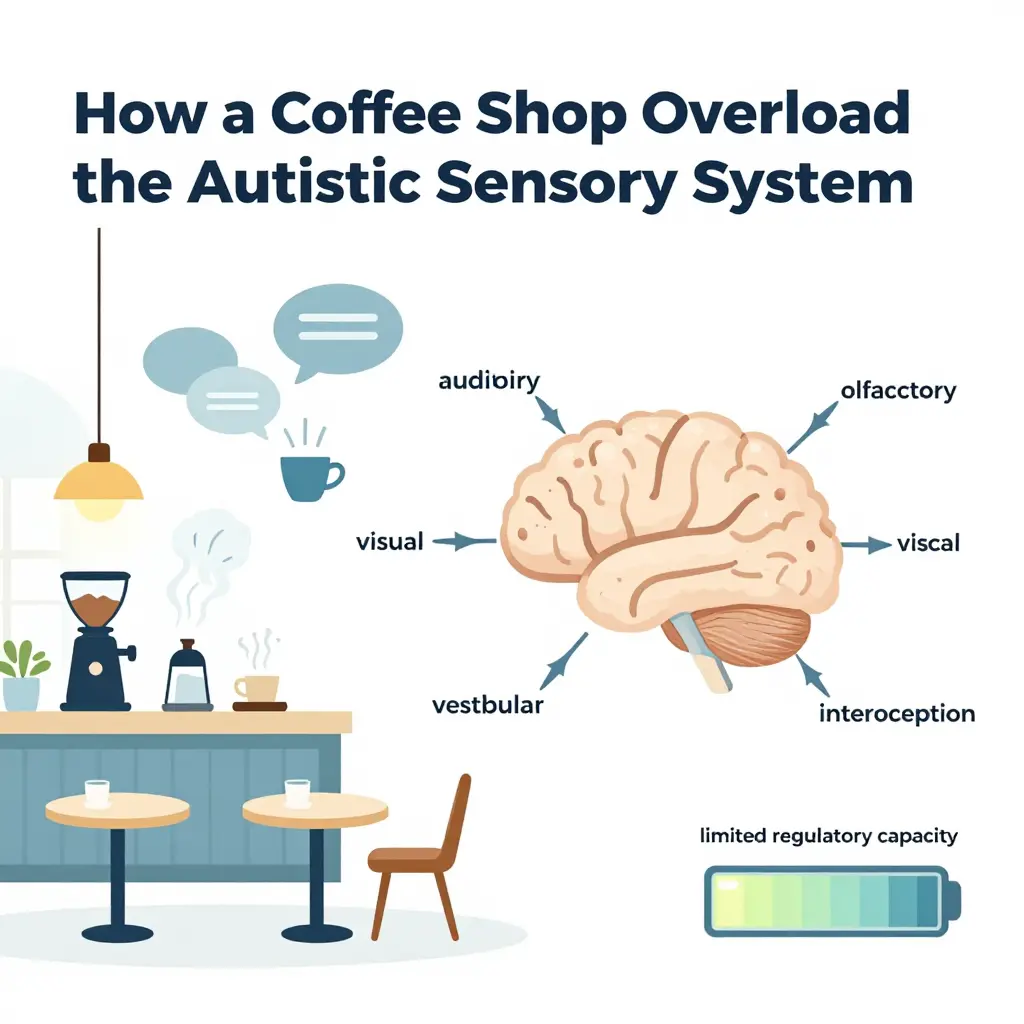
The layering is the problem
No single input is the hard part. The hard part is that they all arrive together.
Unpredictable noise. Espresso grinders whine, steam wands hiss, cups clink, and conversations overlap. None of it comes with warning, so the brain has nothing to predict against and nothing to filter out; the auditory channel stays on high alert.
Strong, overlapping smells. Roasted beans, steamed milk, flavored syrup, cleaning spray, and perfume blend into one cloud. Smell goes straight to the brain’s emotional centers, so even a “pleasant” aroma can land as an intrusion.
Warm, shifting light and temperature. Windows glare, then cloud over. Bodies and machines push heat around while the door keeps letting cold in. A child who reads temperature closely never quite settles.
Crowding and social demands. Tight seating means bumped chairs and accidental touch. Then come the questions – what do you want, can you say that again – each one another task on a plate that is already full.
Why the channels compete
The nervous system has a limited pool of regulatory energy, and every sensory channel draws from the same pool. When hearing is working hard, less is left for smell, vision, touch, or balance. One busy sense turns into every busy sense.
One input amplifies the next:
- A grinder starts, triggering a startle response
- The startle drains regulation energy that would normally filter background sound
- With less filtering, chatter and clinking feel louder than they really are
- The louder the room feels, the sharper smell and temperature become
- As more channels overload, spoken words get harder to decode
- That stacking finally tips the system into overwhelm
Interoception and emotions under strain
Interoception tells a child how they feel inside: hungry, tired, too warm, or close to a meltdown. Under strain, those early warnings stop arriving. A child may not realize a break is needed until they are already past their limit, and emotional regulation has less to work with, so big feelings come fast. This is a nervous system carrying too much at once, not misbehavior. Forcing tolerance does not help; respecting the load and building regulation slowly does. For families who want steady, structured support, occupational therapy for autism spectrum disorders is one route from these observations to strategies a family can use at home.
How Sensory Input Becomes Overload: A Simple Flow Model
A coffee shop is not “loud” or “busy” in the abstract. It is a stream of separate channels arriving together: the steam wand’s hiss, roasting beans drifting from the counter, glare off tile and glass, people brushing past in a tight space. Everything an autistic child takes in from those channels draws on the same limited capacity. When input arrives faster than that capacity can drain, the system goes past its limit. The diagram below shows the flow: four input channels, one central processing figure, and two ways out – overflow (overload) and a coping loop (regulation).
You rarely get to remove the noise. You can widen the drain. Every goal later in this article – cutting one channel, adding a recovery loop, building in a pause – amounts to an edit to this picture. To see how those edits become structured, measurable goals, see occupational therapy for autism spectrum disorders.
Recognizing the Signs of Sensory Overload in a Coffee Shop
For many autistic children, a room can shift from pleasant to overwhelming in seconds. The steam wand hisses, cups clatter, conversations murmur, roasted beans drift over from the counter, and the line presses in. Learning to read the signs of overload is one of the more useful skills a caregiver or educator can develop.
Signs look different from child to child. Some children escalate outward, getting louder and more active. Others shut down, going quiet and hard to reach. Both are real, and both need the same gentle response. Catching them early creates time to regulate before the moment turns into a crisis.
Observable Signs to Watch For
- Covering ears, pressing hands over the head, or pulling a hood down over the eyes
- Vocalizing, humming, or repeating phrases to self-soothe or block out noise
- A sudden increase in stimming, such as hand-flapping, rocking, or leg bouncing
- Fleeing toward exits, doorways, or quiet corners away from the crowd
- Freezing or going quiet, staring blankly, or becoming unresponsive to their name
- Refusing to eat or drink, pushing food away, or dropping a favorite treat
- Physical agitation, including squirming, pacing, or tensing the whole body
- Escalating toward a meltdown, with crying, shouting, or throwing items
Overload or a Choice?
How do you tell overload apart from a behavioral choice? Look at the trigger and the recovery. Overload builds out of sensory input, has no obvious goal, and does not stop just because an adult asks. A behavioral choice usually works toward something, looks the same across settings, and responds to reasoning or negotiation.
When it is unclear, treat it as overload. Lower the input, offer an exit, and give the child room. Changing the environment – dimmer light, a seat away from the crowd, noise-reducing headphones – often prevents the next episode. Occupational therapists work on adapting environments for patient needs in the same way. The observations get easier with practice, and a stressful outing becomes a manageable one.
What Occupational Therapy Goals Actually Change
Whether a visit ends in a meltdown or passes without one has less to do with luck than with what the goals on paper actually ask a child to do. A target like “tolerate the community” sounds reassuring in a meeting and gives no one a next step. You cannot practice “tolerating,” and you cannot measure it. A function-based goal names the action, the setting, and how much support is allowed, which makes progress visible to everyone. For how sensory and daily-living supports fit together, see this guide to occupational therapy for autism spectrum disorders.
The difference in plain terms:
| Vague Goal | Measurable, Function-Based Goal |
|---|---|
| “Tolerate the community” | “Enter a coffee shop and stay 8 minutes with headphones, on 4 of 5 trips” |
| “Improve sensory processing” | “Use 2 calming strategies from a visual menu when noise increases” |
| “Better transitions” | “Switch from a preferred to a non-preferred activity within 60 seconds with one verbal prompt” |
| “Ask for help” | “Say or sign ‘break’ before distress escalates, 3 times per session” |
Each of these could be scored by someone who had never met the child.
Sensory Regulation and Co-Regulation Strategies
Change looks like a child reaching for a chosen tool – noise-reducing headphones, a fidget, deep pressure – before overload peaks. Track how often it happens and how many minutes earlier than last month. Co-regulation counts as well; a goal might read “accept a familiar adult’s calming routine within 30 seconds of a cue.”
Graded Community Exposure and Desensitization
Exposure works in small, testable steps: standing outside the door, then at the entrance, then at one table. Change looks like two or three more minutes of comfortable time each week, or finishing a full errand with a single break. The aim is a wider window of tolerance, not endurance for its own sake.
Self-Advocacy and Requesting Breaks
This goal hands control to the child, which is why it carries so much weight. A measurable version: “independently requests a break using a card, word, or device in 4 of 5 opportunities, before crying or leaving the area.” You can count the requests, note whether they came early or late, and watch them replace escalation.
Interoception and Recognizing Internal Signals
Interoception is noticing hunger, a racing heart, or a full bladder – signals many autistic kids register late. Change looks like naming a body state correctly (“my tummy feels tight”) or acting on it by drinking water or seeking quiet, without being prompted. A simple body-check chart is enough to track accuracy.
Transition Flexibility
Rigid transitions account for a lot of public meltdowns. A flexible goal might read “ends a preferred activity given a two-minute warning and a visual timer, with no more than one protest.” Count the prompts needed and the recovery time; fewer prompts and faster recovery is the progress you are after.
Environmental Modification Skills
Sometimes the strongest goal changes the room instead of the child. Change looks like a child or caregiver adjusting light, seating, or noise before distress starts. Count how often the adjustment happens ahead of trouble rather than after it.
Why Collaboration Makes These Goals Stick
Goals written only in a clinic tend to fade. When occupational therapists, parents, and educators build them together, the same language, cues, and measures carry between home, school, and the coffee shop. You can sharpen those shared targets with the goal-setting strategies occupational therapists find effective. Data collected across settings turns a hopeful sentence into evidence that changes outcomes.
Which Occupational Therapy Goals Move the Needle Most?
Some goals do more than others when the goal is a calm trip to a busy coffee shop. The chart below compares six common goal categories on a 0-100 scale we use here for ranking – a rough guide to how strongly each tends to show up in a child’s day-to-day participation, not a clinical measure.
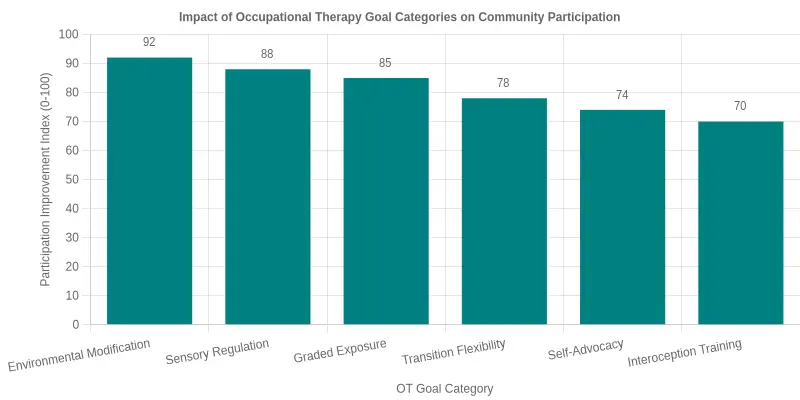
Caption: Framed around real community moments, occupational therapy goals for autism tend to pay off fastest through environmental modification and sensory regulation. Interoception and self-advocacy take longer, and they build the independence that keeps a coffee-shop outing working after the sessions end.
Environmental Adaptations and Sensory Strategies That Support Participation
When a child melts down in a busy coffee shop, the first instinct is often to teach a new skill. Skills take time. Changing the environment can reduce distress today, which is why occupational therapy treats environmental modification as the fastest lever available: it works before skill-building has a chance to take effect.
A crowded, echoing cafe is hard on a child who is sensitive to input. Lowering the sensory demand is what makes participation possible instead of overwhelming. In practice, that means:
Reducing Sensory Demand
- Seating choice. Pick a corner booth, a spot near a wall, or an outdoor table. High-backed seats buffer sound and reduce visual traffic, while facing a quiet wall limits constant movement in the child’s field of view.
- Timing visits around quieter hours. Mid-morning or mid-afternoon windows avoid the rush. Fewer people means less noise, less jostling, and shorter waits.
- Noise-reducing tools. Earmuffs, ear defenders, or loop earplugs take the edge off grinding blenders and espresso machines. Many families keep a pair in the bag as standard kit. You can explore more options in this guide on tools and equipment for occupational therapists.
- Visual or picture schedules. A simple sequence showing order, pay, sit, drink helps a child predict what comes next and reduces anxiety.
- Pre-visit preparation. Review the plan at home, watch a short video of the shop, or role-play ordering so the routine feels familiar.
- Agreed exit or break plans. Decide on a signal, a word, or a card that means “I need a break.” A calm, no-blame exit protects trust and keeps future visits positive.
Occupational therapists coach families on these adjustments routinely. If you want to go deeper, this overview of how occupational therapists adapt environments for patient needs explains the reasoning behind each choice.
A Step-by-Step Coffee Shop Preparation Sequence
A plan to run through before the next visit:
- Choose a quiet time. Call ahead or check the shop’s slowest hours, then aim for that window.
- Preview the trip. Show a picture schedule or short video so the child knows the order of events.
- Pack sensory kit. Bring earmuffs, a fidget, a preferred snack, and any comfort item.
- Set the plan together. Agree on where you will sit and choose a break or exit signal everyone understands.
- Pick the calmest seat. Head for the corner booth or wall-adjacent table as soon as you arrive.
- Order in small steps. Let the child point, say one word, or hand over the card to reduce language pressure.
- Watch for early cues. Covering ears, fidgeting, or going quiet means it is time for a break, not a problem to push through.
- Debrief afterward. Praise what worked and note one tweak for next time.
Changes made before a meltdown starts do more in the moment than months of practice afterward. Build the environment around the child and participation follows.
How Occupational Therapy Goals Actually Get Built
Before a goal can reduce a meltdown at the coffee counter, it moves through a process that repeats. The flowchart below follows it from the first sensory conversation to the point where a family notices the plan is working.
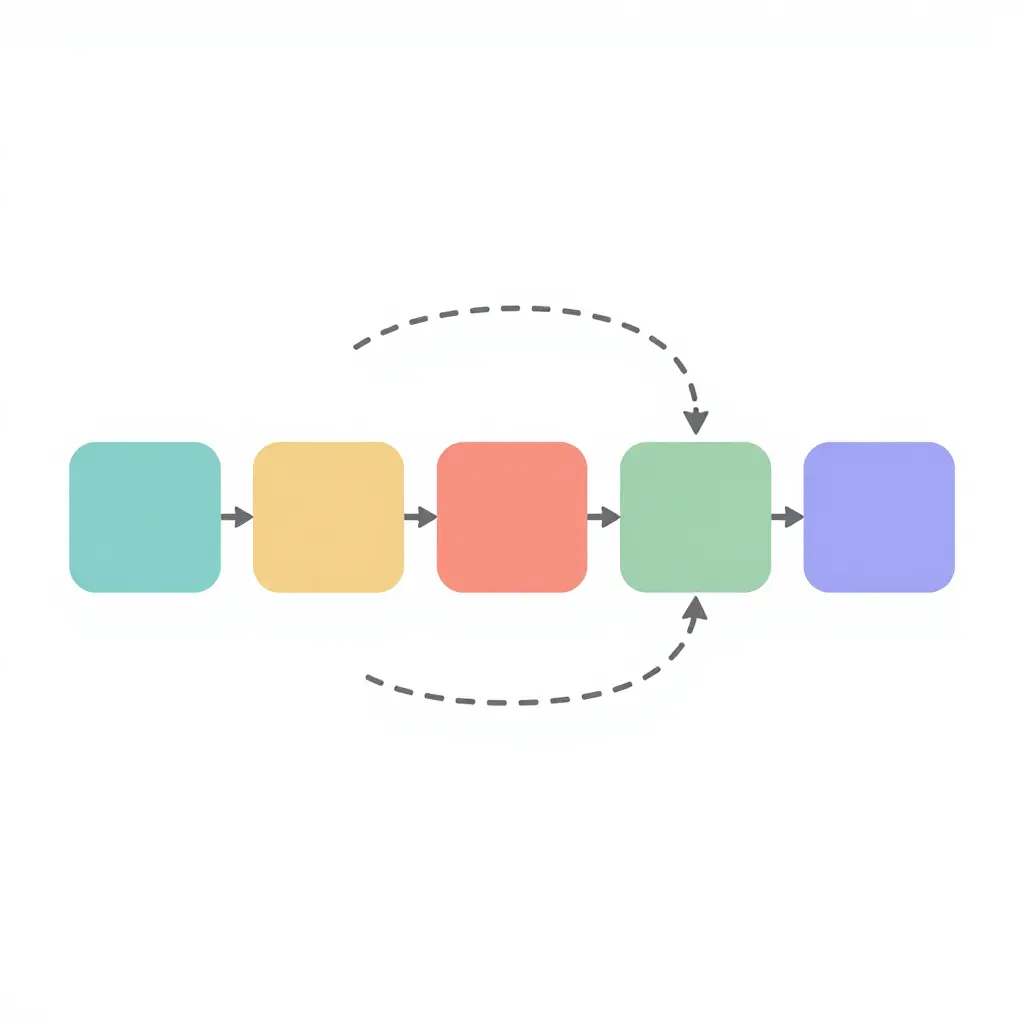
Treat it as a loop rather than a straight line. You rarely finish once and walk away.
The five stages, up close
- Assessment of the sensory profile. The therapist gathers what a child’s nervous system does with sound, light, smell, texture, and movement, ideally in the actual community setting rather than a quiet clinic room.
- Identification of participation barriers. Here the team names the specific snags: the espresso grinder’s sudden pitch, the queue that never seems to move, the door that slams. Vague is the enemy.
- Collaborative goal drafting. Goals get written with the family, not for them, in language a child can understand and a teacher can support.
- Strategy implementation. Coping tools, environmental tweaks, and practiced routines move into the real world: headphones, a visual order card, a chosen seat near the exit.
- Progress review. Everyone checks whether the coffee run got easier, then loops back to adjust. If a strategy flops, that is data, not failure.
If you want the language of measurable targets in more detail, this guide to effective goal-setting strategies in occupational therapy breaks down how therapists turn a broad wish like “handle the coffee shop” into something trackable.
Collaboration Between Occupational Therapists, Parents, and Educators
A calming routine practiced once a week in a clinic rarely changes a Tuesday morning at the coffee shop counter. Sensory strategies work when they travel. Progress happens when occupational therapists, parents, and educators share one plan and use it the same way.
Everyone Owns a Piece of the Plan
Occupational therapists bring the clinical reasoning: they assess sensory profiles, spot triggers, and design strategies. Parents bring daily context, the details no assessment captures. Educators bring the classroom rhythm, where sensory needs show up in groups. When the three trade notes instead of working separately, occupational therapy goals for autism stop being paperwork.
Consistent Cues and Language
If a therapist calls a break a “sensory reset,” the classroom aide should not call the same thing “time out.” Matching cues, visuals, and phrases across home, school, and clinic reduces confusion for autistic kids and builds trust. A child hears the same signal at the kitchen table, at a desk, or in a busy café.
Collecting and Reviewing Progress
Progress shows up in data, not guesswork, and the simplest tools work best: a shared log of how often dysregulation happens, a short before-and-after note, or a quick rating scale. Parents track home patterns, educators note classroom moments, and therapists pull it together in review meetings. The same approach tracks how occupational therapists collaborate with other healthcare professionals to align care across settings.
From Clinic to Community
A goal like “tolerate a busy coffee shop for ten minutes” starts small: practice at the clinic, then at home, then in a real café. Teachers reinforce it during transitions, parents rehearse before outings, and therapists adjust as the child grows. The role of an occupational therapist in schools makes the transfer smoother by keeping supports in the classroom.
Same plan, same words, same goal: that is what carries a sensory strategy past the clinic walls.
FAQ: Coffee Shop Sensory Overload and Occupational Therapy Goals
What exactly counts as sensory overload in a coffee shop?
Layered triggers: hissing steam wands, clattering cups, background music, strong coffee smells, crowded seating. Overload happens when those inputs pile up faster than the nervous system can process them, which can bring on a meltdown, a shutdown, or a sudden urge to leave. It is not simply “loud noise” – it is the total of sights, sounds, smells, and movement at once.
Can occupational therapy goals for autism actually change a child’s tolerance for noisy spaces?
Tolerance can be built. Occupational therapy goals for autism typically target sensory regulation, coping strategies, and graded environmental exposure, and these can raise a child’s threshold over time. The aim is not to “cure” sensitivity but to build skills so a child can take part with less distress.
How long does it take to see progress on community participation goals?
It varies widely. Many families notice early shifts after 6 to 12 weeks of consistent practice. Generalization that holds up – ordering a drink calmly, sitting through a short visit – usually takes several months to a year. Small wins are worth marking along the way.
Should parents avoid coffee shops entirely, or is gradual exposure better?
Avoiding coffee shops altogether narrows a child’s world and can increase anxiety over time. Most therapists favor graded exposure: short visits at quiet, off-peak hours, then adding time, noise, and transitions slowly. The child’s regulation sets the pace.
How do occupational therapists measure change in sensory regulation goals?
OTs combine standardized sensory profiles, goal attainment scaling (GAS), and direct observation – recovery time after a trigger, for instance. Parent and teacher reports capture change in daily life that a clinic test may miss. Progress is recorded against specific participation goals.
What should educators do during a school outing to a cafe environment?
Preview the setting with photos, assign a quiet buddy or a calm corner, and bring noise-reducing headphones. Keep expectations simple and agree on an early exit if regulation breaks down. Afterward, log what triggered trouble and what worked. For more, see our guide to occupational therapy for autism spectrum disorders.
Key Takeaways
A meltdown in a coffee shop is not misbehavior. It is a nervous system responding to a flood of noise, light, smell, and motion, and through the lens of sensory processing it becomes predictable and workable.
The occupational therapy goals for autism that change outcomes tend to share one quality: they are specific enough that someone else could score them. “Tolerate the community” rarely moves anything. Concrete ones, like “order a drink using a visual script in a busy cafe three times”, do.
The levers stay the same across settings. Catch the early signs – ears covered, squinting, agitation climbing – before overload peaks. Change the environment with quieter corners, off-peak hours, and familiar routines. Set regulation and self-advocacy goals so kids can name what they need and ask for a break. Keep parents, therapists, and educators on the same plan so strategies carry from clinic to classroom to cafe.
None of it is dramatic. It is a series of small, steady wins, and it adds up to outings that go better than they used to.