
Caffeine is a critical component of coffee that influences taste, aroma, and customer experience. As a business owner in the coffee industry, grasping the caffeine content in coffee beans, specifically in Arabica and Robusta varieties, is vital. This knowledge can affect product offerings, customer satisfaction, and pricing strategies. The caffeine content per bean can vary significantly, ranging from 1 to 4 milligrams, depending on the type of bean. In the following chapters, we will delve deeply into the caffeine content found in a single Arabica and Robusta coffee bean, explore the various factors influencing caffeine levels, discuss the health implications related to caffeine consumption, and understand how bean caffeine content impacts the brewing process. By understanding these details, business owners can make informed decisions that align with their customers’ preferences and health considerations.
null
null
Per-Bean Caffeine: How Much Does One Robusta Seed Deliver?

Estimating caffeine per Robusta bean starts with simple numbers: weight and percentage caffeine. A typical Robusta bean weighs about 0.15 grams and often carries 2.2% to 2.7% caffeine. Using the midpoint, 2.45%, the per-bean caffeine comes out around 3.7 milligrams.
That means ten beans yield roughly 37 milligrams, though roasting, bean size variation, and extraction during brewing can move this figure. The bean is a small data point, but its cumulative effect matters when you count dozens or hundreds of beans in a cup or a shot.
For contrast, Arabica beans typically run lower in caffeine, around 1.2% to 1.5% by weight. With the same 0.15-gram bean, that translates to roughly 1.8 to 2.3 milligrams per bean, underscoring how bean choice can steer the caffeine profile of a brew.
From Bean to Buzz: Unraveling the Hidden Factors Behind Caffeine in a Single Coffee Bean
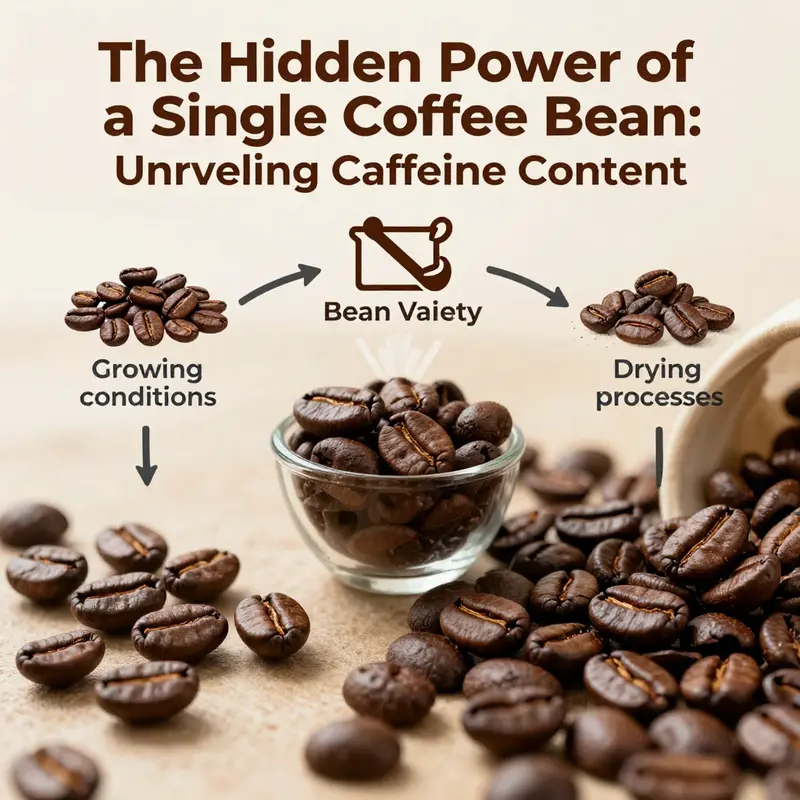
A single coffee bean carries more than flavor and aroma. It holds a small but telling chemical story about how much caffeine it has, and that story is written in a blend of biology, climate, and processing history. When we ask how much caffeine is in one bean, the answer is not a single number but a range shaped by the plant’s species, the place it grew, and the journey it took from cherry to cup. This perspective helps explain why a bean is never simply “high caffeine” or “low caffeine” in a vacuum. It is the product of a complex, context-rich biology that translates into the caffeine we detect in our morning brew and, more importantly, in the minutes after the first fragrant whiff hits the air.
The most fundamental divider in this story is the plant species. The two most prominent commercial beans, Arabica and Robusta, differ markedly in their caffeine content, and those differences are not minor. In the living plant, caffeine serves multiple roles, including deterring pests and shaping seed development. The recent scholarship on caffeine content at the bean level places Arabica in a gentler range and Robusta in a stronger one. Specifically, Arabica beans tend to harbor caffeine in the lower-mid percent range, while Robusta beans push into the higher percent range. Those percentages translate quietly into milligrams when you consider the bean’s mass. Arabica beans are typically lighter, while Robusta beans are often larger and heavier, which compounds the total caffeine carried by each individual bean.
To be precise, the detailed measurements show Arabica beans about 1.1% to 1.3% caffeine by weight, whereas Robusta beans generally fall around 2.2% to 2.7%. Those percentages are not simply abstract numbers; they tell a story about how much caffeine sits inside a single seed. When you translate those percentages into real-world bean sizes, you get a useful sense of the caffeine payload you’re likely to encounter per bean. Arabica beans, which are commonly weighed at roughly 0.15 to 0.2 grams, carry on the order of about 1.7 to 2.6 milligrams of caffeine per bean. Robusta beans, traditionally larger and heavier, can deliver roughly 5.5 to 8.0 milligrams per bean, depending on the exact size and weight of the bean in question. These are not precise guarantees for every single bean—nature loves variation—but they offer a practical window into the typical spread you might see on a tasting table or a coffee scale.
It’s tempting to read those numbers as fixed rules, but the reality is that the weight of a bean matters as much as its caffeine percentage does. The Arabica bean weights often cluster around 0.15 to 0.2 grams, and a 1.1% to 1.3% caffeine content translates directly into the milligram range mentioned above. Robusta beans, which can be notably denser and heavier, push the caffeine mass per bean higher when you apply the same percentage calculation. The same principle explains why a handful of Robusta beans can contribute noticeably more caffeine to a cup than a handful of Arabica beans, even when the two bean sets are prepared with similar brewing methods.
Beyond species, the environment in which a coffee plant grows helps shape the caffeine content in the bean. Altitude is a widely discussed factor among growers and researchers because it influences plant stress, leaf density, and the maturation process. Higher-altitude plants often produce beans that are denser and harder. That density does not just affect texture; it can correlate with slight shifts in caffeine concentrations. The logic is pragmatic: caffeine is part of the plant’s chemical arsenal, a defense mechanism that can intensify in response to environmental pressures. When environmental stressors like cooler nights, stronger day-night temperature swings, or greater pest challenges are present, the plant’s chemistry tends to adjust. The result, at the bean level, can be a modest uptick in caffeine content, though the shift is typically small relative to the overall range set by species.
Similarly, how much sunlight a plant receives can subtly influence bean chemistry. Limited sunlight can alter photosynthetic efficiency and the energy landscape within the seed as it develops. The caffeine content, tied to metabolic pathways in the seed, may shift in response to these conditions. The story here is not that sunlight suddenly makes a bean caffeine-rich or caffeine-poor; rather, it nudges the internal chemistry in a direction that may elevate or reduce caffeine by a fractional margin. When combined with altitude, these environmental pieces add depth to the simple categorical division of Arabica versus Robusta. They remind us that a bean’s caffeine payload is a product not only of species but of place and climate as well.
Roasting completes the arc from seed to cup by changing the bean’s physical mass, but it does not dramatically rearrange the inherent caffeine content. The roasting process causes mass loss, primarily through the evaporation of water and the release of volatile compounds, while caffeine itself remains relatively stable at the temperatures typical of roasting. This means that a light roast and a dark roast of the same bean species and origin will show only a slight difference in caffeine per bean, and that difference is often negligible in practical terms for most home brewers and cafes. In other words, the inherent caffeine payload that sits in the seed remains mostly intact even as the bean darkens and expands in aroma and color. What changes with roast is not so much the caffeine inside the bean as how much of that caffeine is available to be extracted when hot water passes through the grounds.
That distinction becomes critical when we consider brewing variables. Water temperature, brew time, grind size, and pressure together determine how much caffeine actually makes it into the cup, even though the bean’s internal caffeine content stays largely the same. A finer grind, a longer extraction, or a higher brew temperature can coax more caffeine from the same beans than a coarser grind or shorter contact time. Yet, if you were to measure the caffeine within the bean itself—before any water touches it—the amount remains largely dictated by the species, the bean’s weight, and the plant’s environment. The cup, in other words, is not a direct mirror of the bean’s internal caffeine percentage but a product of how that caffeine is liberated by a particular brewing approach.
In practical terms, this means that a coffee made from Arabica beans at a given roast will deliver less caffeine per bean on average than a coffee made from Robusta beans, assuming similar weight and extraction parameters. However, the exact caffeine in a cup can be tuned by the barista or the home brewer through grind size, temperature, and time. The same bean can yield a milder, more caffeinated, or somewhere in between cup depending on how it is prepared. That convergence of biology and technique is what makes the caffeine story so nuanced: beans contain a baseline caffeine content rooted in species and environmental history, while the cup reflects the art of extraction and the science of chemistry in equal measure.
For readers seeking a precise, science-forward anchor, a landmark study in the Journal of Agricultural and Food Chemistry provides a rigorous look at how these factors play out in real-world measurements. The study outlines the range of caffeine content by species and highlights the minimal impact of roasting on caffeine, while acknowledging how environmental context can influence the seed’s chemistry. This work moves beyond simple dichotomies and invites us to think about caffeine as a property that emerges from the plant’s life history, not just a fixed attribute stamped onto a bean at harvest. If you want to explore the science in greater depth, you can consult the detailed findings shared by the researchers at the following link: https://pubs.acs.org/doi/10.1021/jf504698n
In sum, the caffeine inside a single coffee bean is a small but telling fingerprint of a plant’s identity, its growing conditions, and its processing journey. Arabica beans carry a lighter caffeine load per seed, generally around the 1.7 to 2.6 milligram mark, while Robusta beans carry more, often in the 5.5 to 8 milligram range per bean, with exact figures oscillating with bean size and origin. The field shows how altitude, sunlight, and climate quietly nudge caffeine levels, while roasting and brewing shape how much of that seed-bound caffeine ends up in the cup. The result is a layered truth: caffeine in a bean is a product of biology plus environment, and caffeine in a cup is the outcome of technique plus taste preference. Both stories—the seed’s chemistry and the brewer’s craft—are essential to understanding not just how much caffeine is in one bean, but how much caffeine you ultimately experience in your daily cup.
Tiny Buzz, Big Implications: Decoding the Caffeine Inside a Single Coffee Bean
Caffeine sits at the heart of the coffee experience, a tiny molecular stimulant whose presence in a single bean invites big questions. When we ask, how much caffeine is in one coffee bean, the answer is not a single figure but a spectrum shaped by plant biology, processing, and even the way we measure. The broad story begins with the bean’s species. Arabica beans, the more delicate and widely prized variety, typically harbor caffeine in the range of roughly 0.9% to 1.4% by weight. Robusta, the hardier and more bitter counterpart, carries caffeine more prominently, often between 2% and 4% by weight. Those percentages translate directly into per-bean estimates: given that an average Arabica bean weighs about 0.15 to 0.2 grams, you’re commonly looking at about 1 to 2 milligrams of caffeine per bean. Robusta beans, which tend to be larger and heavier, can push that per-bean caffeine content to around 3 to 4 milligrams. In practical terms, a single bean provides only a whisper of caffeine, yet the whisper is loud enough to matter when you tally up your daily intake. The numbers seem simple, but the science behind them reveals a landscape of variation that can feel almost paradoxical in its precision and contradiction.
What makes this landscape paradoxical is that the same topic—caffeine in a single bean—shows starkly different estimates across sources. Some detailed compilations report markedly lower figures, suggesting a range as modest as 0.1 to 0.2 milligrams per bean. That handful of tenths of a milligram would imply a much smaller per-bean contribution than the conventional 1–4 mg range described above. On the other hand, broader measurements that examine caffeine as a percentage by weight and then apply typical bean masses align with the 1–4 mg per bean range. The discrepancy invites careful interpretation. It’s not that one set of measurements is correct and the other wrong; it’s that different study designs, bean states, and counting methods can yield divergent outcomes. For instance, some analyses look at green, unroasted beans, while others examine roasted beans whose weight has changed due to moisture loss and structural transformation. The roasting process does not erase caffeine, but the weight loss concentrates it in the remaining mass, potentially altering the per-bean figure when you compare roasted beans to green ones. The bottom line is that the caffeine content per bean is real, but the exact micro-number depends on what you measure and how you count.
To illuminate this complexity, researchers often move beyond the per-bean lens and speak in terms of concentration by weight, measured in milligrams per gram (mg/g). In many studies, the average concentration lands around 10.0–12.0 mg/g, although there is substantial variation. In the extreme ends of the spectrum, decaffeinated varieties display much lower caffeine concentrations, sometimes as low as 0.01 mg/g, while certain robust, intensely caffeinated specimens can reach nearly 19.9 mg/g. These figures underscore a crucial point: caffeine content is highly sensitive to biological and processing factors. When you convert concentration into a per-bean dose, the result still stays in the few-milligram neighborhood for most common beans, but the exact number can swing with even small changes in weight, moisture, and bean surface area.
If we translate concentration into the familiar unit of caffeine per coffee bean, the arithmetic becomes more tangible for everyday life. Consider that a standard Arabica bean, weighing about 0.15–0.2 g, with a caffeine concentration around 10–12 mg/g, yields roughly 1.5 to 2.4 mg of caffeine per bean. Even when you factor in a Robusta bean’s higher concentration and mass, you’re rarely venturing far beyond the 3–4 mg per bean mark. These ballpark figures align with the often-cited rule of thumb that a single coffee bean holds a milligram-or-two of caffeine, with Robusta nudging that estimate toward the higher end. Yet the precise number will still depend on the exact weight of the bean, the species, and how it was processed before you encountered it.
Health implications in this context look modest. A single bean, regardless of species, sits well below thresholds associated with physiological effects. The real physiological impact comes from a cup or more of brewed coffee, not from nibbling a few beans. A typical cup—roughly 240 milliliters—contains about 95 to 200 milligrams of caffeine, depending on the roast level, grind size, and brewing method. That cup delivers the caffeinated punch many people seek, a response driven by cumulative intake rather than any one bean’s bite. In this sense, the per-bean caffeine figure serves as a reminder of proportion: a solitary bean does not stand as a meaningful dose; it is the aggregate that moves the needle on alertness, heart rate, and metabolism. Health authorities routinely cite a daily limit around 400 milligrams for healthy adults, a ceiling that is far above what a handful of beans would contribute on any given day. The per-bean metric helps debunk two myths at once: that caffeine can be consumed in a truly “bean-sized” dose and that a single bean could independently steer energy or mood in a predictable way.
The variability in per-bean caffeine content also has practical implications for those who treat coffee as a sensory and culinary artifact rather than a simple energy source. People who forage for beans, sample micro-lots, or roast their own coffee may notice differences in caffeine character across lots or harvest years. Those variations can arise from changing climates, soil composition, harvest timing, and even distinguishing the beans’ developmental stage when picked. Because caffeine is synthesized in the plant as a protective compound, its concentration often tracks species and environmental stressors as much as roasting, and thus the per-bean figure remains a moving target across landscapes.
From a measurement perspective, one must also recognize the distinction between caffeine per bean and caffeine per weight. If you weigh a large handful of beans, you can accumulate a meaningful dose, especially if the handful consists of Robusta or a coffee with elevated caffeine concentration. But counting beans alone is a poor predictor of caffeine intake without knowing either the bean’s mass or its caffeine percentage. This nuance matters to researchers who study caffeine exposure and to consumers who are curious about the lore surrounding “bean caffeine.” When measured in mg/g, caffeine content appears relatively robust, but the per-bean conversion remains sensitive to the exact dimensions of the bean in question. The resulting portrait is one of a tiny stimulant whose quantity is real, variable, and ultimately bounded by the biology of the plant rather than a mysterious secret hiding inside each bean.
For those seeking a more rigorous anchor, the Journal of Agricultural and Food Chemistry published work exploring how caffeine concentration varies among single beans. The study highlights that there can be meaningful fluctuation from one bean to the next, even within the same lot, underscoring why scientists emphasize distributions rather than single values when characterizing caffeine content. In practice, this means two beans from the same batch could carry slightly different caffeine amounts, and a careful consumer or researcher will want to average across multiple beans to obtain a representative figure. For a detailed, peer-reviewed discussion of this variability, see the study on Variation in Caffeine Concentration in Single Coffee Beans. External readers can consult the original publication for the methodology and data behind these general observations: https://pubs.acs.org/doi/10.1021/jf403657p.
Beyond the numbers, the cultural and culinary context matters. People often chew on a few coffee beans for a quick bite of caffeine, a habit common in some cultures and coffee landscapes. For anyone who does this, the per-bean dose, while small, is not zero. It can contribute to energy intake when multiple beans are consumed in a short period. Yet the practical takeaway remains consistent: one bean is not a reliable or sufficient caffeine source for meaningful physiological effects. The appeal of coffee, then, lies not in the caffeine stamp on a single bean but in the choreography of beans, grind, water, heat, and time that culminates in a cup—an orchestration that delivers a predictable caffeine punch only when scaled up from the unit to the serving.
In sum, the story of caffeine in one coffee bean is less about a single, fixed number and more about a spectrum shaped by species, weight, and processing. While Arabica beans are typically lighter and carry less caffeine per bean than Robusta, the actual content can vary widely within each category. The most robust conclusion is that a single bean, whether Arabica or Robusta, contributes only a minuscule fraction of caffeine compared with a cup of coffee, and the health implications of nibbling a few beans are negligible for most people. For those who want to dive deeper into the data and the nuances of measurement, the referenced study and related literature provide a richer map of how caffeine content is observed across the coffee bean spectrum, reminding us that the chemistry of a single bean is both surprisingly stable in theory and wonderfully variable in practice.
External resource: https://pubs.acs.org/doi/10.1021/jf403657p
Caffeine by the Bean: Decoding How One Coffee Seed Sets the Pace for Your Cup
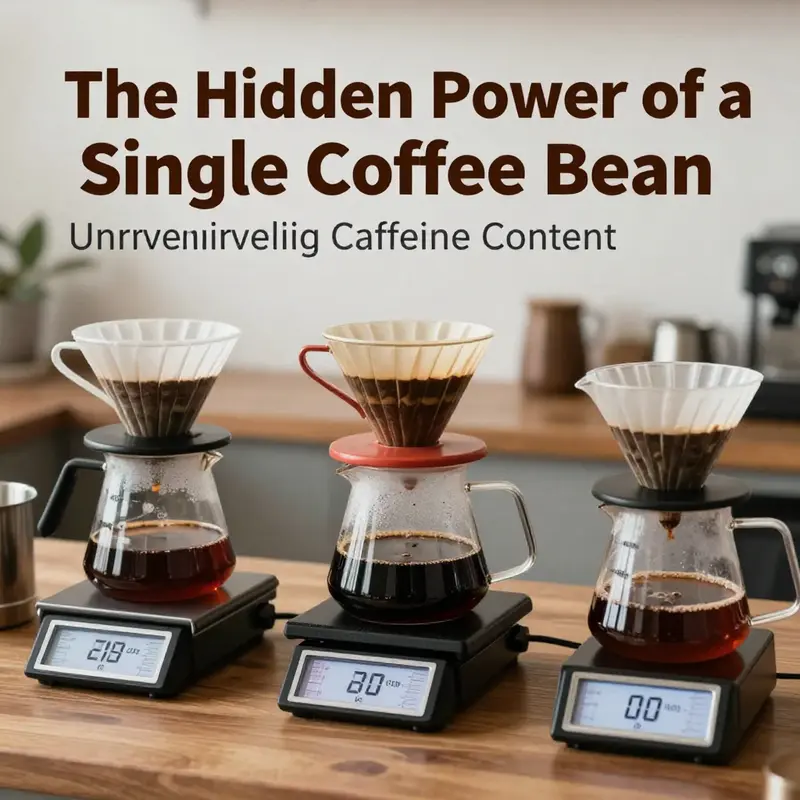
Ask most people how much caffeine sits in a single coffee bean, and they expect a neat, exact figure. The reality is subtler and more intriguing, because that tiny seed carries a signal that is amplified, transformed, and tempered as it travels from the roaster’s drum to the cup in your hand. This chapter follows that journey, not to glorify a number, but to reveal how the amount per bean interacts with the patient mathematics of extraction and the craft of brewing. It is a story that begins with a grain of weight and chemistry and ends in a mug that can sharpen focus, alter mood, or simply deliver a comforting ritual. The path from seed to sip requires us to hold two truths in tension: the seed-level caffeine is a small component, yet the finished cup routinely delivers a robust dose thanks to the processes that extract, concentrate, and deliver caffeine to your palate. In other words, the bean is a tiny actor in a much larger stage, where method and mastery determine the final performance.
The most direct way to talk about caffeine in a bean is to start with a baseline: how much caffeine does one roasted bean contain? Contemporary measurements in everyday roasted coffees often place a single bean in a four- to six-milligram band. That range may surprise readers who learned early on that caffeine is a defining feature of Robusta or that Arabica tends to be gentler on the nerves. The disparity between these two claims becomes understandable once you acknowledge the variables that surround a bean’s life before it even reaches your cup. The classic weight-based estimates—Arabica beans hovering around 0.9 to 1.4 percent caffeine by weight, Robusta around 2 to 4 percent—provide a theoretical framework. If you take a modest Arabica bean weighing roughly 0.15 to 0.2 grams, the math would yield about 1 to 2 milligrams of caffeine per bean under those percentage assumptions. Robusta, larger and often heavier, would push that content higher, potentially into the 3 to 4 milligram range per bean on paper. Those numbers are instructive, but they capture a snapshot of composition rather than the everyday reality of roasted beans sitting on shelves. When researchers pull samples of roasted beans and measure caffeine after processing, the results frequently align with a slightly higher, more practical figure—roughly four to six milligrams per bean. The shift from theoretical percent concentrations to observed roast-level values reflects the messy truth: beans are not perfectly uniform, roast levels change the structure and water content of the seed, and the peak caffeine signal you experience depends on how much of that signal survives the roast and how it is measured.
Even as a singular bean tends to cling to a modest caffeine payload, the real drama unfolds in the transition from seed to cup. Caffeine does not exist in a vacuum; its fate is bound up with the physics and chemistry of extraction. The brew is a process, not a single act. Grind size acts like a dial on surface area: grind finer, you expose more surface to the water, and caffeine can dissolve more quickly. The temperature of the water matters too. Hotter water tends to pull caffeine out more efficiently, but it also accelerates the extraction of bitter compounds and other solubles, which may alter taste and mouthfeel. The brewing method imposes a distinct rhythm. Espresso, with its short but intense contact time under pressure, concentrates caffeine into a compact shot. Drip or pour-over methods involve longer interaction with water, allowing caffeine to accumulate across a larger volume of liquid. The net effect is that two cups of coffee can deliver the same caffeine content even if they come from different origins and roasts, simply because the pathway from bean to cup differs in its tempo and energy. In practical terms, a one-ounce shot of espresso typically houses about 60 to 80 milligrams of caffeine, while an eight-ounce cup of drip coffee can range from roughly 95 to 200 milligrams. These figures illuminate an essential truth: a single bean’s caffeine is only a starting point. The brew’s final dose emerges from the collective action of many beans and the craft of extraction itself.
The story becomes more nuanced when we compare bean varieties, roast levels, and the attitudes of different brewing cultures toward caffeine. Arabica beans, known for their nuanced flavors and generally lower caffeine content, contribute less caffeine per bean than Robusta in many practical contexts. Yet the caffeine signal from Robusta is not a simple one-to-one forecast for every cup. Robusta’s higher caffeine content can be offset or amplified by how much Robusta is used in a blend, how the roast is executed, and how long the grounds sit in contact with water during extraction. Roast level adds another layer of subtlety. Light roasts tend to retain more caffeine by weight than dark roasts because caffeine is relatively stable through the roasting process, and lighter beans retain more mass and moisture content that can influence extraction dynamics. Dark roasts may appear to offer less caffeine per bean in some measurements, but the difference is often modest compared with the total caffeine per cup. In essence, the shoulder-to-shoulder competition between bean type and roast is not a simple arithmetic clash; it is a conversation about how much caffeine makes it through the extraction gate and into the cup you drink.
The dual realities—the seed-scale caffeine and its cup-scale expression—invite a practical, if not a rigid, set of expectations. For someone watching caffeine intake for health reasons or athletic performance, the seed-level numbers are a guide to what could be possible, while the brewing realities show what is probable in a everyday setting. A key takeaway is that the exact count per bean is not a fixed destiny. The same seed content can, through different preparation choices, produce a high-dose or a comparatively modest cup. This is why two people might sip similar-looking coffees yet report different levels of alertness or jitters. A consumer who buys a light roast, grinds coarsely, and uses a slower pour-over method may experience one caffeine profile, while the same bean in a darker roast prepared as a quick espresso might yield a different, equally valid experience. The science does not promise uniformity; it offers a framework for understanding variability and for making informed choices that align with one’s preferences and needs.
In practical terms, then, the idea of a single caffeine count per bean serves as a starting point for a broader conversation about how coffee is made and enjoyed. The seed’s tiny amount matters less in isolation than in the context of how many seeds are used and how the brewer manipulates the water, heat, and contact time. A handful of carefully chosen beans can deposit a comfortably predictable caffeine dose, while a rushed extraction with a coarse grind can dilute that effect, producing a gentler cup. The variability is not a flaw; it is a feature of a beverage that is both a science and an art. The numbers—four to six milligrams per bean in many practical roasted samples, the espresso range of sixty to eighty milligrams per shot, and the drip range of roughly ninety-five to two hundred milligrams per cup—provide a map for navigating your own caffeine landscape. But the most important takeaway is the recognition that the bean is a starting point, not the final word. If you want to understand your daily caffeine intake, you must consider both the seed’s inherent potential and the path that takes that potential into your cup.
For readers seeking a solid data reference to ground these reflections, the USDA FoodData Central provides comprehensive nutritional data for caffeine in coffee forms and offers a foundational resource for understanding how caffeine content scales from bean to cup. While exact per-bean figures can vary with variety and processing, the overarching patterns—how caffeine accrues with extraction and how brewing choices influence final intake—remain consistent across well-designed analyses. For a detailed data set and ongoing updates, consult the USDA FoodData Central at https://fdc.nal.usda.gov/.
Final thoughts
Understanding the caffeine content in a single coffee bean is crucial for business owners in the coffee industry. The distinctions between Arabica and Robusta beans not only impact the flavor and quality of the coffee but also play a pivotal role in meeting customer expectations and health considerations. As such, a comprehensive awareness of caffeine levels can empower business owners to craft menus, set appropriate pricing, and educate customers, enhancing overall satisfaction. Ultimately, informed decisions backed by knowledge of caffeine content reaffirm a commitment to quality and customer care in a competitive market.