
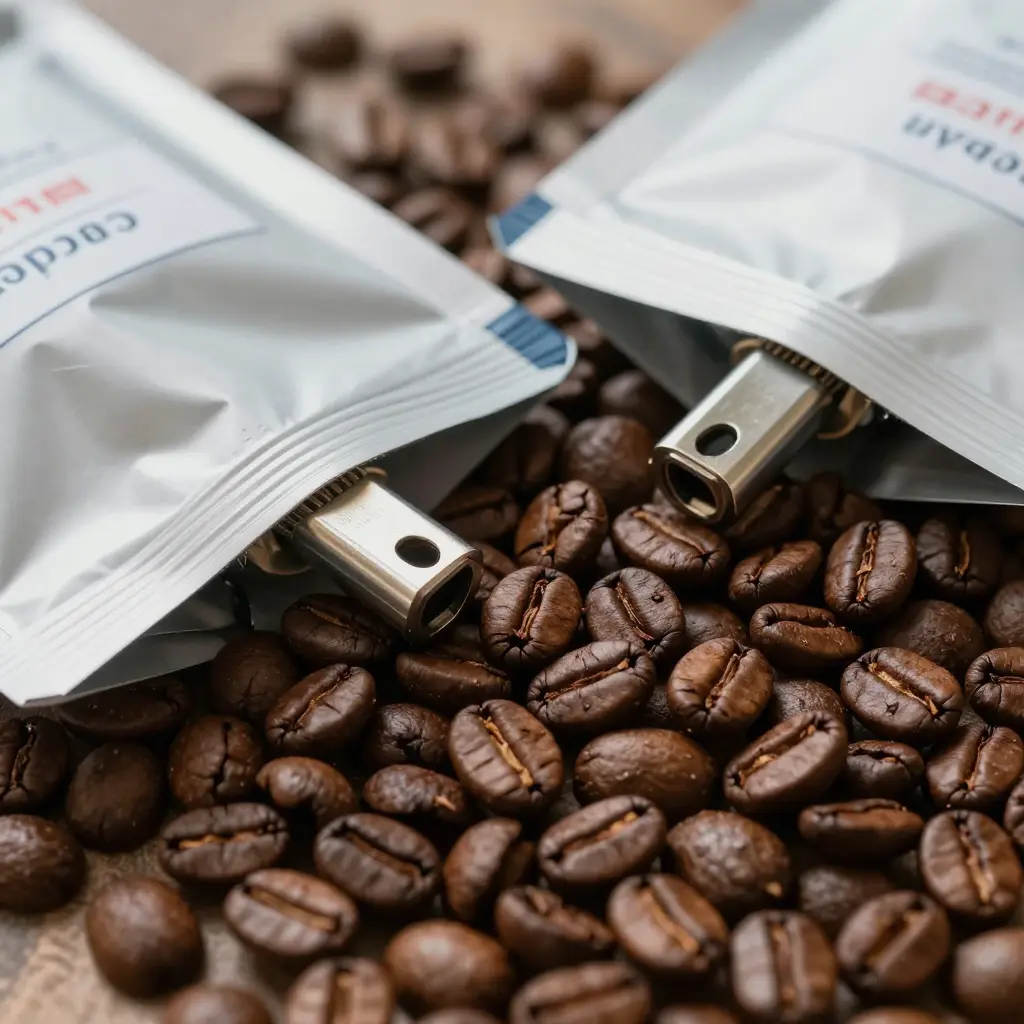
The Roasting Chemistry That Generates Carbon Dioxide
Every Roasted Bean Becomes a Pressurized Vessel
A green coffee bean starts out dense and low in gas, with almost no internal pressure. A few minutes in a roaster changes that: the bean turns into a small pressure vessel. The carbon dioxide in coffee is not added during packaging, brewing, or handling. The roast makes it, as heat-driven reactions turn solid compounds stored in the bean into gases. Knowing which reactions produce that gas explains why freshly roasted beans keep venting for days, and why holding the gas becomes an engineering problem.
Three Reaction Pathways That Release CO2
The Maillard Reaction
Once bean temperature passes roughly 150°C (300°F), amino acids react with reducing sugars in the Maillard reaction. The browning builds aroma and flavor, but it also breaks larger molecules into smaller ones. Carbon dioxide forms as a byproduct alongside water vapor and fragrant volatiles, and Strecker degradation of amino acids adds more gas-forming fragments.
Caramelization
Above about 170°C (340°F), sugars begin to break down on their own, without nitrogen. Caramelization splits sucrose and other carbohydrates into hundreds of smaller compounds, and those decomposition pathways release carbon dioxide and other volatiles. The same reaction darkens the bean and deepens sweetness, so gas production and roast development happen together.
Pyrolysis
Beyond roughly 200°C (390°F), the bean reaches first crack and enters pyrolysis, the thermal breakdown of organic matter itself. Cell walls rupture, oils migrate, and the reaction produces large volumes of carbon dioxide and carbon monoxide. This stage accounts for most of the gas trapped in the bean. Because pyrolysis also leaves the cell structure more fractured, darker roasts vent that gas faster in the first days, even though they end up holding less total CO2 than lighter roasts.
The Gas Has Nowhere to Go but Out
By the end of the roast, a good share of the bean’s internal volume is carbon dioxide held under pressure inside a porous, brittle cell structure. The bean cannot hold that pressure forever, so the gas leaks out slowly in the process known as degassing after roasting, which usually continues for several days to weeks. That steady release is what balloons sealed bags and overloads one-way valves. Any packaging solution has to start from the chemistry: the roast itself is the CO2 factory.
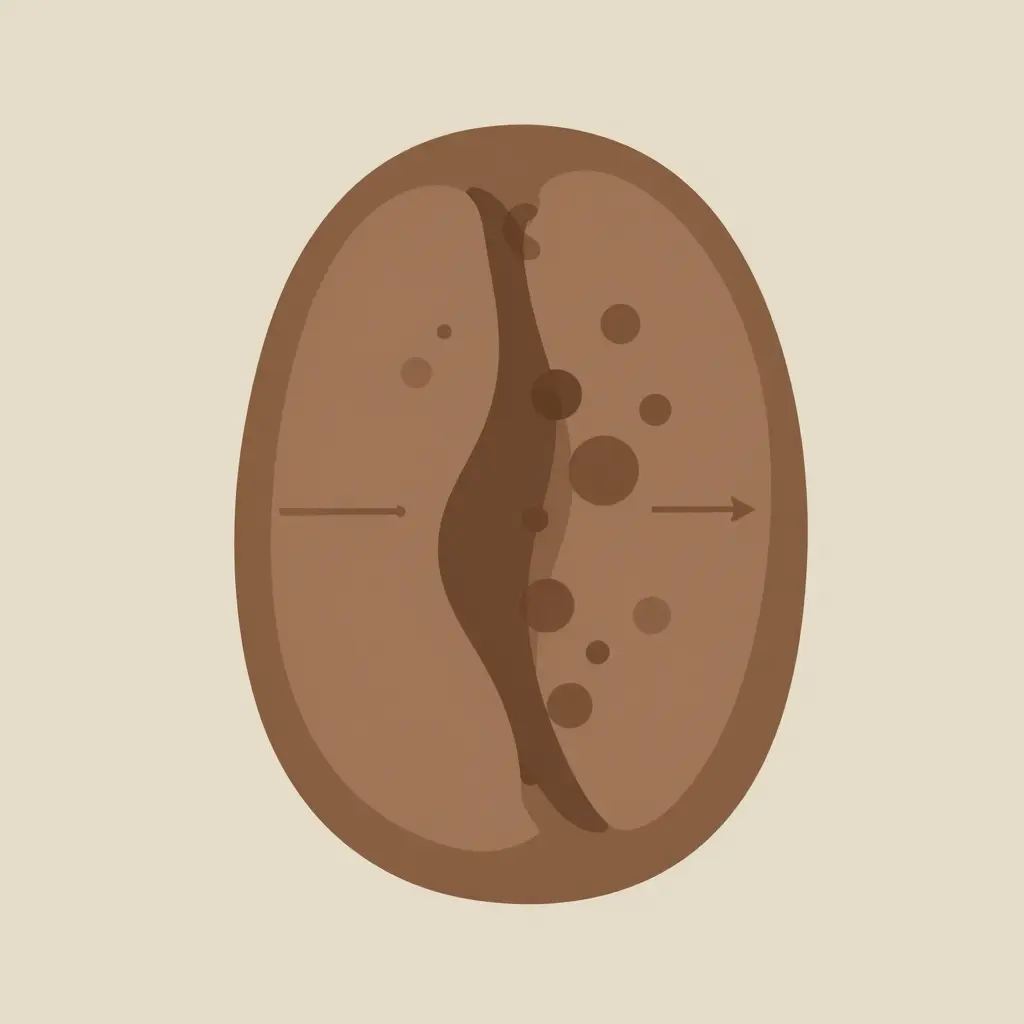
Cross-section view: as roasting drives the Maillard reaction and caramelization, trapped carbon dioxide accumulates in the bean’s porous interior and slowly migrates outward toward the surface – the same mechanism that pressurizes a sealed bag.
The Degassing Timeline: From First Hours to Several Weeks
Freshly roasted coffee behaves like a pressurized product. Within minutes of leaving the drum, beans start venting carbon dioxide trapped in their cell structure during the roast, and the rate follows a predictable shape called the degassing curve. That curve tells you when a sealed bag will swell, when a one-way valve is working hardest, and when a package can finally sit without stress. CO2 release is front-loaded: most of the gas escapes early, then a long, slow tail stretches out for weeks.
The timeline generally unfolds like this.
- First hours (0-6 hours): Beans shed a fast, forceful burst of surface and near-surface gas. A sealed pouch can visibly stiffen within this window.
- First day (6-24 hours): The release rate climbs toward its peak, and valves face their hardest test.
- Days 2-4: The peak release window. Bags balloon fastest, and weak seals are most likely to fail.
- Days 5-10: The rate begins a steady decline, often falling toward roughly half of peak output as internal pressure equalizes.
- Weeks 2-3: A slow, flattening curve. Release continues, but the daily volume drops sharply.
- Weeks 4-6 and beyond: Residual trace amounts escape, tapering toward a near-flat line.
The curve is not fixed. A few variables bend it in consistent directions.
Roast level plays a leading role. Darker roasts develop a more porous, fractured cell structure, so gas escapes faster and earlier.
Bean density matters too. Dense, high-grown beans hold their structure longer, producing a slower and more extended release.
Storage temperature adds another control: warmth speeds up the molecular movement that pushes gas out of the bean.
| Factor | Effect on CO2 release |
|---|---|
| Darker roast | Faster, earlier release |
| Lighter roast | Slower, longer curve |
| High-density beans | Slower, extended release |
| Warmer storage | Accelerated release |
| Cooler storage | Slowed release |
The practical point: degassing is not one event but a gradient that shifts with roast, density, and temperature. Reading that gradient lets roasters and packaging engineers time their seals, select valves, and predict swelling instead of reacting to it.
CO2 Release Over Time: The Degassing Timeline by Roast Level
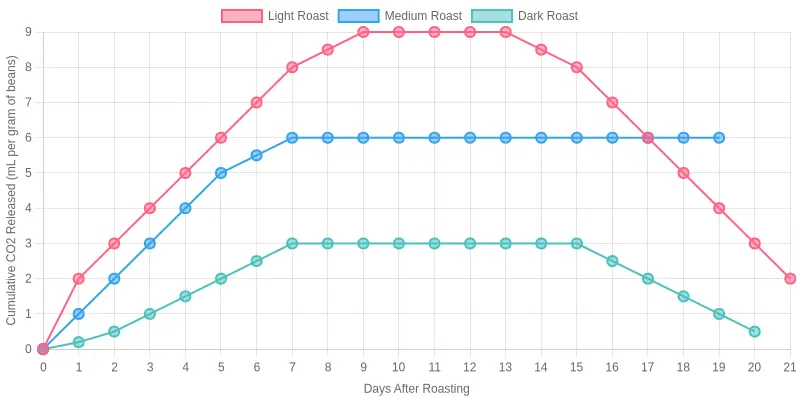
The degassing curve is the best tool for predicting when a sealed bag will balloon. Freshly roasted beans act like carbon dioxide sponges: a kilo of just-roasted coffee can hold several liters of CO2 inside its porous cellulose structure. Once roasting ends, that gas starts to escape, slowly at first, then in a steady rush over the first week, before tapering into a long, low trickle. The chart below tracks cumulative CO2 release over the first three weeks. Roast level makes a bigger difference than most people expect.
How to Read the Curves
The y-axis shows cumulative CO2 released in milliliters per gram of beans; the x-axis counts days after the roast dropped. Three things matter to a packaging engineer:
- The first 48 hours are explosive. Roughly 40-50% of the total gas a bean will ever release escapes in the first two days. This is why bags roasted and sealed the same afternoon can bulge overnight.
- Light roast releases the most, and releases it longest. Lighter roasts spend less time at high temperatures, so less CO2 is driven off inside the roaster. That reserve gets emptied into the bag, stretching the active degassing window out past two weeks.
- Dark roast flattens early. Heavier roasting already vented much of the stored gas during the roast itself. Dark beans often settle within 5-7 days, which is why espresso blends designed for quick turnaround tend to use darker profiles.
Turning the Curve into a Packaging Decision
Read the chart alongside your filling schedule and the decisions become obvious. A bag of light roast sealed on day zero with a one-way valve will vent hard for several days, then quiet down. A dark roast may barely need to vent at all. Any bean still on the steep part of the curve when it goes into a fully sealed, valve-less pouch is a ticking timer toward a bulging, pillow-shaped package. Match the valve, headspace, and fill timing to the curve and ballooning largely stops.
Why Sealed Bags Balloon After Roasting
Open a bag of freshly roasted coffee a day or two after packing and it may be puffed up like a cushion. That is not a defect or a sign of spoilage. It is predictable physics at work inside the package.
Roasting Traps Gas
During roasting a green bean goes through intense chemical change. Heat drives off moisture and triggers Maillard reactions and caramelization, and the bean ends up as a pressurized vessel holding carbon dioxide (CO2) inside its porous cell structure. After the roast, that gas does not stay put. It migrates out of the bean in the process called degassing and collects in the sealed headspace. Because the package is airtight, the CO2 has nowhere to go, and coffee packaging pressure rises.
Volume, Temperature, and Pressure
That trapped gas follows the ideal gas law, PV = nRT. Pressure rises when the number of gas molecules goes up, when temperature goes up, or when volume is held constant. In a sealed bag, all three happen at once. The bean keeps releasing more CO2 molecules (raising n), and ambient warmth during storage or transit raises the temperature (raising T). Because the bag’s volume is mostly fixed, the material has to stretch, and the walls bulge. Volume and pressure are inversely related, so squeezing the bag to shrink its headspace pushes internal pressure higher still. Warmth compounds the effect: a bag in a hot warehouse balloons faster than one kept cool.
Rupture and Seal Failure
Unmanaged pressure is a real packaging hazard. If internal pressure exceeds what the laminate and seams can take, the bag can rupture outright, or the heat seal can split at its weakest point. Either outcome lets oxygen reach the coffee and speeds staling, and either one damages the brand on the shelf. That is why many roasters use a one-way valve, a membrane that lets CO2 out while blocking oxygen. When the valve is undersized or clogged, the same physics returns and the bag balloons anyway.
Conclusion
Sealed coffee bags inflate because roasting sets up a continual release of CO2 into a closed space, and the gas laws turn that trapped gas into pressure. Managing that balance is what drives the choice of valve, film strength, and degassing time before bags ever reach a shelf.
Coffee Packaging Solutions Compared
Once you know how much CO2 freshly roasted beans release, the question becomes which bag actually handles it. The table below compares how the four most common options manage degassing, and where each one helps or hurts your coffee.
| Packaging Type | Degassing Method | CO2 Handling | Key Limitation |
|---|---|---|---|
| Fully sealed bags | None – airtight barrier | CO2 trapped inside; bag balloons and can burst | Pressure build-up risks seam failure and oxygen ingress after rupture |
| One-way valve bags | One-way valve releases gas, blocks air | CO2 escapes while oxygen stays out | Valve can clog with oils or fines and silently fail |
| Perforated bags | Tiny pin-holes in the film | CO2 vents freely through holes | Holes let oxygen in too, so beans stale fast |
| Vacuum-sealed bags | Air and CO2 pulled out, then sealed | CO2 is removed before sealing, but re-emerges | Internal pressure re-inflates the pack; vacuum collapses soft beans |
The trade-off is clear. Anything that lets gas out freely, like perforation, also lets air in; anything that keeps air out, like a fully sealed or vacuum bag, traps CO2 and swells. The one-way valve is the only design that tries to do both jobs, which is why the next section looks at how these valves work and where they fail.
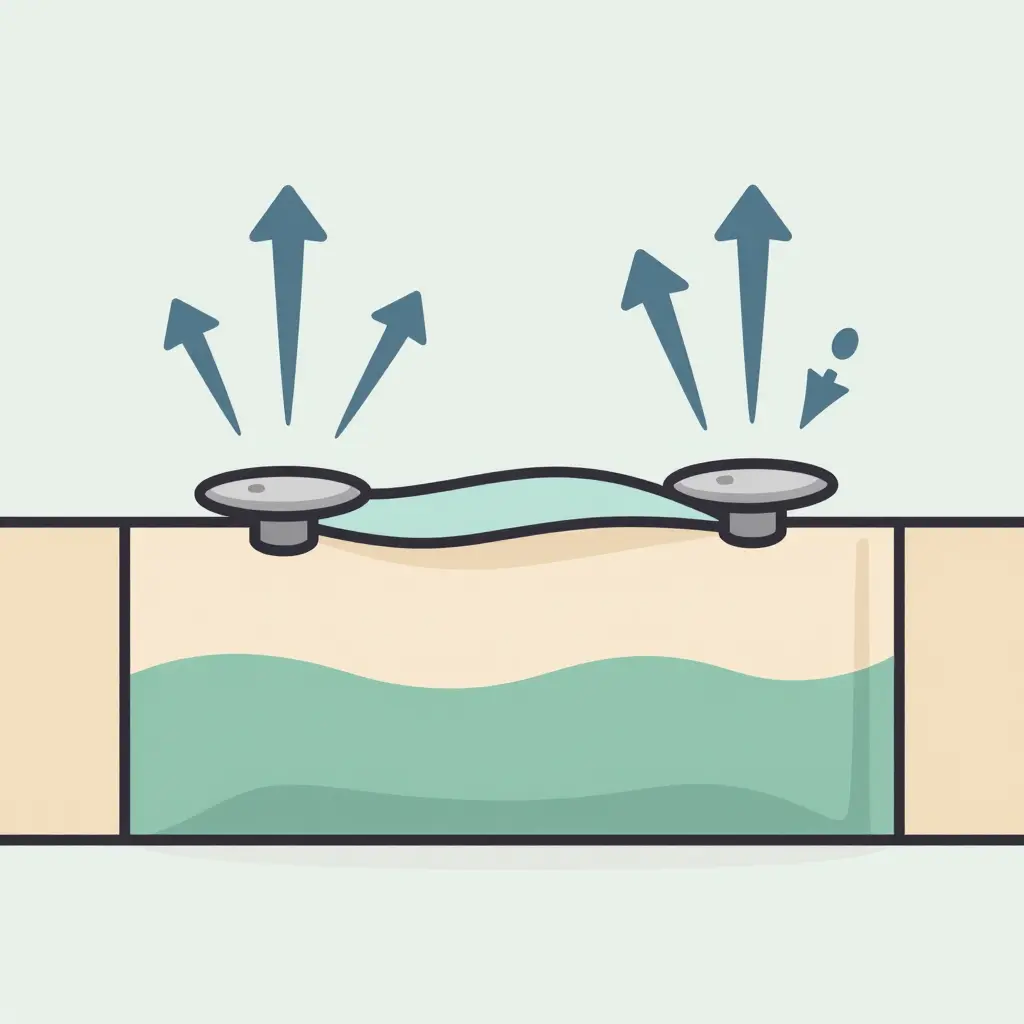
A simplified 2D cross-section of a one-way degassing valve: carbon dioxide built up inside the bag pushes the flexible membrane outward and escapes, while incoming outside air presses the same membrane flat against its seat, sealing the valve shut.
Why One-Way Valves Fail After Roasting
A one-way valve makes a simple promise: let carbon dioxide out, keep oxygen in. Freshly roasted beans test that promise thousands of times a day. Knowing why the valves fail separates a bag that quietly does its job from one that leaves beans staling in a swollen pouch. Most failures come down to a few mechanisms, and they rarely act alone.
Oil and Fine Particle Clogging
Roasted coffee carries oils and tiny fragments of chaff and bean dust. Over time they migrate into the valve’s narrow channels and seat. As residue builds, the opening that should breathe is partly blocked, pressure rises, and the valve either sticks shut or leaks. This is one of the most common sources of degassing valve problems, because the damage is gradual and easy to miss until a bag balloons.
Membrane Fatigue
Many valves use a flexible silicone or rubber membrane that flexes with every pressure cycle. Constant opening and closing wears it down, like a hinge on a door that opens all day. Once the membrane loses its elasticity, it may not reseal cleanly, so air creeps back in even as gas still escapes. Fatigue depends on cycles, not just time, so heavily degassing beans wear a valve out faster.
Valve Orientation
Which way a valve faces matters more than it seems. If gravity pulls oils and moisture toward the seal, debris collects against the membrane; a valve mounted upside down or in the wrong spot may never see the pressure it needs. Correct orientation lets gravity work with the mechanism, draining residue instead of pooling it where it causes damage.
Adhesive Failure
A valve is only as reliable as the bond holding it to the film. Heat, humidity, and the mechanical stress of filling can weaken the adhesive and open a slow leak around the valve’s edge. The valve itself may work perfectly while gas and air slip past its perimeter, with the same result.
Pressure Exceeding Valve Capacity
Every valve is rated for a specific cracking pressure and flow rate. When internal pressure spikes faster than the valve can vent, it is overwhelmed: it may hiss continuously, deform, or simply fail to keep up with an aggressive roast.
The Takeaway
A valve rarely fails from one dramatic event. It fails when clogging, fatigue, orientation, adhesive weakness, and pressure overload add up. Knowing the mechanisms lets roasters and packaging engineers choose better valves, place them carefully, and read a bloated bag as a diagnostic clue instead of a mystery.
Packaging Best Practices to Prevent Degassing Failures
Getting the gas dynamics right is the difference between a bag that breathes and one that balloons. This checklist covers the coffee packaging practices that keep a seal intact.
- Rest before sealing. Allow freshly roasted beans to rest in a vented or open container until the most aggressive CO2 release subsides; sealing too early traps peak off-gassing inside the package.
- Choose the right one-way valve. Match valve flow rate to your roast profile and package size so internal pressure escapes faster than it builds.
- Position the valve carefully. Mount it on the upper panel, clear of folds, seams, and coffee contact, so grounds cannot clog the membrane.
- Select high-barrier materials. Use films with an oxygen transmission rate tuned to your shelf-life target, balancing CO2 escape against oxygen ingress.
- Leave correct headspace. Fill to a consistent level that gives gas room to expand without stressing seals or the valve.
- Package at ambient temperature. Seal only after beans have cooled, since residual heat drives rapid pressure swings that overwhelm the valve.
- Validate valve cracking pressure. Test each valve lot to confirm it opens at the intended pressure and reseals cleanly under load.
- Run accelerated shelf-life tests. Simulate warm storage to confirm seals, valves, and film perform under real-world stress.
- Store and ship sensibly. Keep pallets out of direct heat and avoid stacking that compresses valves or creases the film.
When One-Way Valves Fail: The Most Common Failure Modes
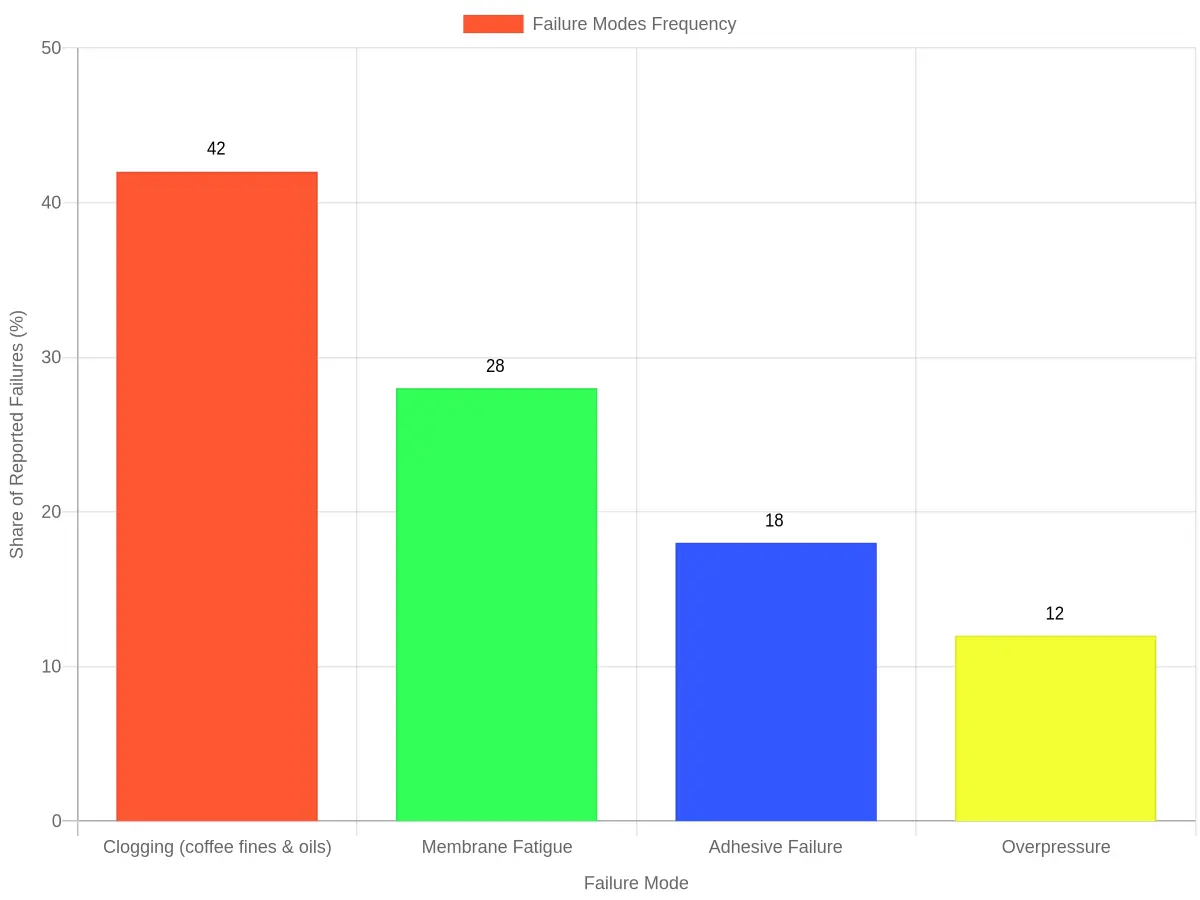
Degassing valves do not all fail for the same reason. When roasters and packaging engineers tear down returned or rejected bags, the causes usually fall into four categories. The bar chart below shows how they stack up in an illustrative survey of packaging complaints.
Reading the Chart
The x-axis lists each failure mode and the y-axis shows its share of reported failures as a percentage. Four results stand out:
- Clogging (coffee fines & oils) – 42%. The clear leader. Fine particles, coffee oils, and condensation migrate into the valve’s micro-channels. Once the silicone membrane and its slits are gummed up, gas cannot escape. The bag balloons, and then either the seal bursts or the valve leaks.
- Membrane Fatigue – 28%. The flexible silicone disc inside the valve opens and closes thousands of times during the active degassing window. Heat, repeated flexing, and time cause the material to lose elasticity, so it stops sealing properly and lets oxygen creep back in.
- Adhesive Failure – 18%. The valve is bonded to the bag with a pressure-sensitive adhesive patch. Oils, moisture, and temperature swings can weaken that bond, letting the valve lift, shift, or peel away entirely – a slow leak that ruins freshness.
- Overpressure – 12%. Least common, but the most dramatic. If the valve clogs or is undersized for a particularly aggressive roast, internal CO2 pressure can spike faster than the valve can vent, leading to puffed, hard bags or a sudden blowout.
Why This Ranking Matters
Clogging and membrane fatigue together account for roughly seven out of ten failures, so the fixes point the same way. Roasters can cut fines and oil migration by resting beans longer before packaging; valve makers can specify higher-grade silicone and wider venting slits. Figure out which failure dominates your own packaging, and you can target the remedy instead of guessing.
| Failure Mode | Share of Reported Failures | Primary Root Cause |
|---|---|---|
| Clogging (coffee fines & oils) | 42% | Fines, oils, and condensation blocking micro-channels |
| Membrane Fatigue | 28% | Repeated flexing and heat degrading silicone elasticity |
| Adhesive Failure | 18% | Weakened pressure-sensitive adhesive bond |
| Overpressure | 12% | Pressure spiking faster than the valve can vent |
Most valve failures are not random accidents. They follow from how coffee degasses and how the valve is built, and once you know the ranking you can design around it.
Valve Material and Film Selection: Matching Hardware to Roast Chemistry
Every roasted bean keeps releasing carbon dioxide for days, and the packaging decides whether that gas slips out quietly or builds up until seals fail. Degassing is less a problem to block than a flow to steer, and the hardware only works when the membrane, the film, and the roast chemistry agree.
The valve membrane does the steering. Most one-way valves use a flexible membrane, usually molded LDPE or a silicone disc, that lifts at a designed opening pressure and reseals as pressure drops. LDPE opens predictably and costs little, but it softens with heat and can deform during hot fill or warm packing. Silicone keeps its elastic seal across a much wider temperature range, which matters when bags sit stacked in warm warehouses.
The film around the valve matters just as much. A typical coffee bag film is a laminate: a PET outer layer for print durability, an aluminum-foil or EVOH barrier against oxygen, and a PE inner sealant that lets slow CO2 migration continue until the valve opens. Thicker sealant layers slow that escape and hold shape better; thinner films release internal pressure faster but can pucker. The table below maps the trade-offs.
| Component | Typical material | Role in degassing | Key limitation |
|---|---|---|---|
| Valve membrane | LDPE | Opens at low pressure, low cost | Softens with heat |
| Valve membrane | Silicone | Stable seal, wide temp range | Higher cost |
| Outer film | PET | Durable print surface | Low CO2 permeability |
| Barrier layer | Aluminum foil / EVOH | Blocks oxygen ingress | Holds CO2 until valve opens |
| Inner sealant | PE | Heat seals, permits slow escape | Oils can weaken the seal |
Oily dark roasts add a wrinkle. Their surface oils migrate into the valve seat and film, where they can clog a membrane or weaken a heat seal. Materials that resist oil absorption, such as silicone membranes and foil-backed film, hold up better than thin laminates that soak oil up.
Treat valve selection and film choice as one system. Match membrane elasticity to the roast’s CO2 output, pair it with a laminate thick enough to resist oil and pressure, and the bag vents instead of bulging.
Frequently Asked Questions About Coffee Bean Degassing
What is coffee bean degassing?
Coffee bean degassing is the natural release of carbon dioxide (CO2) and other gases that build up inside beans during roasting. Green beans hold trapped gases, and the heat of roasting transforms sugars and organic compounds, producing large volumes of CO2 as a byproduct. After roasting, that gas works its way out of the bean over days or weeks.
It is why freshly roasted coffee behaves so differently from older coffee. As beans degas, they shed carbon dioxide that would otherwise interfere with water extraction. That is why baristas often let roasted beans rest before pulling espresso shots.
Why do coffee bags balloon after roasting?
Sealed coffee bags balloon because the CO2 released by fresh beans has nowhere to go. In an airtight, rigid container, the gas accumulates and builds internal pressure that visibly inflates the package.
It does not mean the coffee has spoiled; it confirms the beans are releasing gas. Ballooning is strongest in the first 24 to 72 hours after roasting, when CO2 production peaks. Without a vent, some packages swell noticeably, and the trapped gas can eventually threaten the package’s integrity.
What is a degassing valve and how does it work?
A degassing valve is a small one-way valve built into coffee packaging that lets CO2 escape while keeping oxygen out. It usually contains a flexible membrane or silicone disc that opens under slight internal pressure and lets gas vent.
When internal pressure drops, the membrane reseals against atmospheric pressure and blocks outside air. That protects the coffee from oxidation, a primary cause of staleness, and it lets roasters pack coffee right after roasting without waiting for full degassing.
How long does coffee bean degassing take?
The timeline depends on the roast level, bean density, and processing method. As a general guide:
| Time After Roasting | Typical CO2 Release |
|---|---|
| 0-24 hours | Very high |
| 1-3 days | High |
| 4-7 days | Moderate |
| 8-14 days | Low |
| 15+ days | Minimal |
Lighter roasts tend to degas more slowly at first than darker roasts, because a darker roast has a more porous, fractured structure that releases gas quickly. Most vigorous degassing is done within the first week, though a small amount continues for weeks.
Can a one-way degassing valve fail?
Yes, and they usually fail one of two ways. They can stick closed, so the bag balloons and traps pressure. Or they can leak and stay partly open, letting oxygen in and degrading freshness.
Common causes include fine coffee dust clogging the membrane, manufacturing defects, poor valve placement, or shipping damage. Clogging is especially common with finely ground coffee, where small particles work into the mechanism and block the venting path.
Does degassing affect coffee flavor and freshness?
Degassing has a strong effect on flavor. Right after roasting, excess CO2 can make extraction uneven and produce sour or gassy brews. Resting the beans lets that gas escape so water can extract flavor compounds evenly.
At the same time, degassing exposes beans to oxygen, and oxidation eventually flattens aroma and sweetness. The goal is balance: enough rest to release CO2, and storage that limits oxygen exposure with a working degassing valve.
Should I store coffee in a sealed bag or a valve bag?
For freshly roasted coffee, a valve bag is usually the better choice. The valve manages internal pressure and restricts oxygen at the same time, which covers both ballooning and oxidation. A fully sealed bag with no valve can bulge, and once it is opened it offers no protection against incoming air.
Keep coffee in its original valve bag, squeeze out excess air, and store it in a cool, dark place. If you roast your own beans, resting them briefly before sealing reduces strain on the valve.
The Bottom Line on Coffee Bean Degassing
The ballooning bag is not a mystery; it is chemistry doing what chemistry does. Freshly roasted coffee is a pressurized system, and packaging either works with that pressure or fights a losing battle.
The evidence is consistent. During roasting, Maillard reactions and pyrolysis trap carbon dioxide inside the bean’s porous cell structure. Over the following days that gas steadily escapes through coffee bean degassing. A single kilogram of beans can release several liters of CO2 within the first 24 hours. A sealed bag with no escape route collects that gas until pressure stretches the film, stresses the seams, and puffs the package into a firm cushion.
One-way valves are the usual answer, but they are not infallible. A valve depends on a balance between internal pressure and a flexible membrane, and fine coffee dust, oily residue, or moisture can defeat it. When the cracking pressure is misjudged or the valve sticks shut, gas backs up and the bag balloons anyway.
Packaging strategy is the deciding factor. Matching valve type, film permeability, and fill timing to a given roast profile keeps beans fresh, protects the seal, and prevents the bulge that signals a system under strain. Get the balance right and degassing becomes a managed process instead of a slow-motion failure.